Table of Contents
Welcome to the first 2026 edition of “Japan Rail Enthusiast Magazine”
Hello from a cold Japan—although Tokyo is far from the coldest place in the country. As is usual at this time of year, the railway network—particularly along the Sea of Japan coast, across much of northern Tohoku, and in Hokkaido—is coping with heavy snowfall, strong winds, and frozen points.
While Japan generally handles winter conditions better than the UK (where I originally come from), the weather can still disrupt public transport—and, for that matter, road transport as well.
And to reference the UK again: Tokyo, which sees very little snow (if any), can—like London—come to a grinding halt with just a couple of millimetres. Yet less than two hours outside the city, life carries on with two, or even three, metres of snow.
For JR East, January has been a bad month with major disruption in Tokyo, the story is below.
We have been busy working on rail enthusiast and Exploring Japan by Train tours for both this year and next year. Whether you are an individual or a group we can definitely help you with planning and arranging interesting Japan tours covering the many aspects of Japan’s railways. Contact us today and we can discuss what we can do to help you!
Stephen Turner
TS Japan Rail / TS日本鉄道旅行企画株式会社
Tokyo Rail Chaos! Over a million people affected…
16th January is probably one day that many people in Tokyo will want to forget!
A power failure effecting the JR Yamanote and JR Keihin Tohoku Line between Tamachi and Shimbashi through the moring commute for over a million people into chaos.
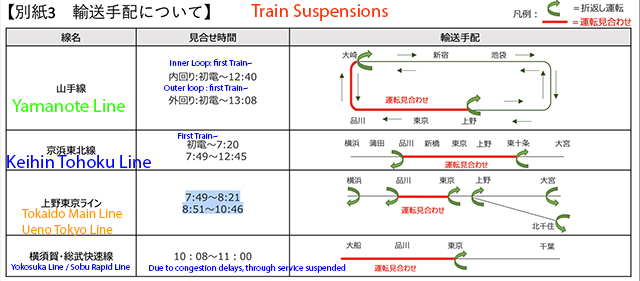
The JR Yamanote Line that circles the central part of Tokyo, whole line and later between Osaki and Ueno, and the north~south Keihin Tohoku Line, between Shinagawa and Higashi Jujo were suspended for all or most of the morning due to the power failure Also between the Tokaido Main Line was also suspended for much of the morning between Shinagawa and Tokyo.


- Yamanote Line suspended between Osaki and Ueno via Shinagawa & Tokyo;
- Inner Loop First train~12:40
- Outer Loop First train~13:08
- Keihin Tohoku Line, suspended between Higashi Jujo~Shinagawa
- First suspension (north & south bound) First Train~7:20
- Second suspension (north & southbound) 8:51~12:45
- Tokaido Main Line / Ueno Tokyo Line: suspended between Tokyo and Shinagawa
- First suspension (up & down Lines) 7:49~8:21
- Second suspension (up & down lines) 8:51~10:56
- (through services between Utsunomiya, Takasaki, Joban Lines and Tokaido Main Line terminated at Ueno or Tokyo and Shinagawa)
- Yokosuka Line ・Sobu Rapid Line through services suspended with trains turning at Tokyo.
Over 1 million people affected, Much of the Tokyo rail network thrown into chaos!
JR East estimates that 673,000 of its passengers on these lines were affected by the suspension, but in reality the number affected was probably over 1 million as congestion on other lines that go through or around central Tokyo also faced delays, due to the congestion, as people tried to find alternative routes resulting in very long queues at stations, some even having to close access at times due to overcrowding. In total 675 train services were cancelled and 174 trains delayed (on the affected JR lines) with the longest delay being 485 minutes for a Keihin Tohoku Line train (this and a second train were stranded between stations for several hours)
The Ministry of Land, Infrastructure, Transport and Tourism (MLIT) asked for bus companies in and around Tokyo to run more / provide extra buses to help ease the chaos.
Cause
Overnight engineering work in the Tamachi area led to the power being deactivated between Tamachi and Shimbashi. The power was due to be restored at 3:50 in time for the first Yamanote Line service. The power restoration, according to JR East’s explanation, was not carried properly as the devise used to ground the power supply (1500V DC) thus cut it off was not removed as it should have been when the power was switched back on. This caused the outage on the Yamanote Line.
A further problem occurred as a result of the above error which caused a small fire in trackside equipment and led to the Keihin Tohoku Line which had resumed services to be suspended again. Tokaido Main Line also had to be stopped due to all of this and also so that passengers on a couple of stranded Keihin Tohoku Line trains could be detrained. The Tokaido Main Line runs parallel to the Yamanote and Keihin Tohoku Lines.
More information in Japanese: https://www.jreast.co.jp/press/2025/20260123_ho01.pdf
Actions to avoid reoccurrence and minimise disruption
JR East has updated procedures for situations like this where power is deactivated and reactivated including further checks and verification that the grounding device has been removed. It has also introduced new procedures to be able to restore power more quickly in case of incidents like this.
JR East will also do the following to help passengers:
- Change procedures on train evacuations so that passengers are not left on stranded trains for extended periods (Yamanote Line and Keihin Tohoku Line trains do not have toilets)
- Better disseminate information to passengers on the situation, alternative routes, congestion levels etc.
One draw back of Japan’s comprehensive rail network, particularly in the big conurbations, is that the amount of through running of trains, both on the same company’s lines, but also across other companies’s lines means that an incident in one place can cause disruption over a very wide area. Also as we saw with this incident although Tokyo has quite a lot of “alternative routes” if one major route is out of service there can still be major impact on other lines (delays and restricted access) due to passenger congestion.

Despite these occasional problems the Japan rail system is very reliable!
Book Recommendation- The Contrasting Faces of Rural Railways in Japan: Volume 1 – East Japan (English Edition)
One of our philosophies at TS Japan Rail is to draw on local information and local experts to offer clients fresh ideas. This may sound obvious, but many visitors to Japan rely on travel guides, travel blogs, and social media posts written by other visitors.
We’re therefore delighted to introduce this e-book on Japan’s local lines, authored by local rail enthusiast Masataka Isashiki. This first volume focuses on East Japan: “The Contrasting Faces of Rural Railways in Japan, Volume 1: East Japan.”
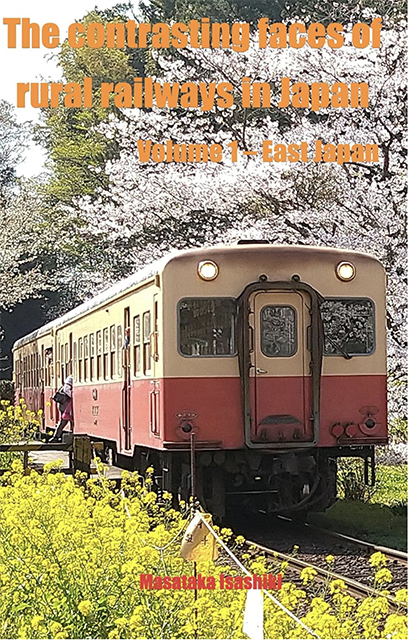
This volume covers 30 non-JR railways across the Kanto, Tohoku, Hokkaido, and Koshinetsu regions of Eastern Japan.
For each railway, the book includes a brief description and history, along with practical information on how to get there and the types of trains operated by the company.
It’s a handy reference for rail enthusiasts (and anyone else) who wants to explore Japan’s many rural railways.
The book is published as a Kindle e-book on Amazon, so you can access it while travelling without having to carry a physical copy.
It is priced at ¥2,949 on Amazon.com.
(TSJR’s policy is not to receive any commissions for our recommendations; our recommendations are fully independent.)
Hakone Tozan Railway to introduce new trains in fiscal 2028 to improve passengers enjoyment of the Hakone mountains…
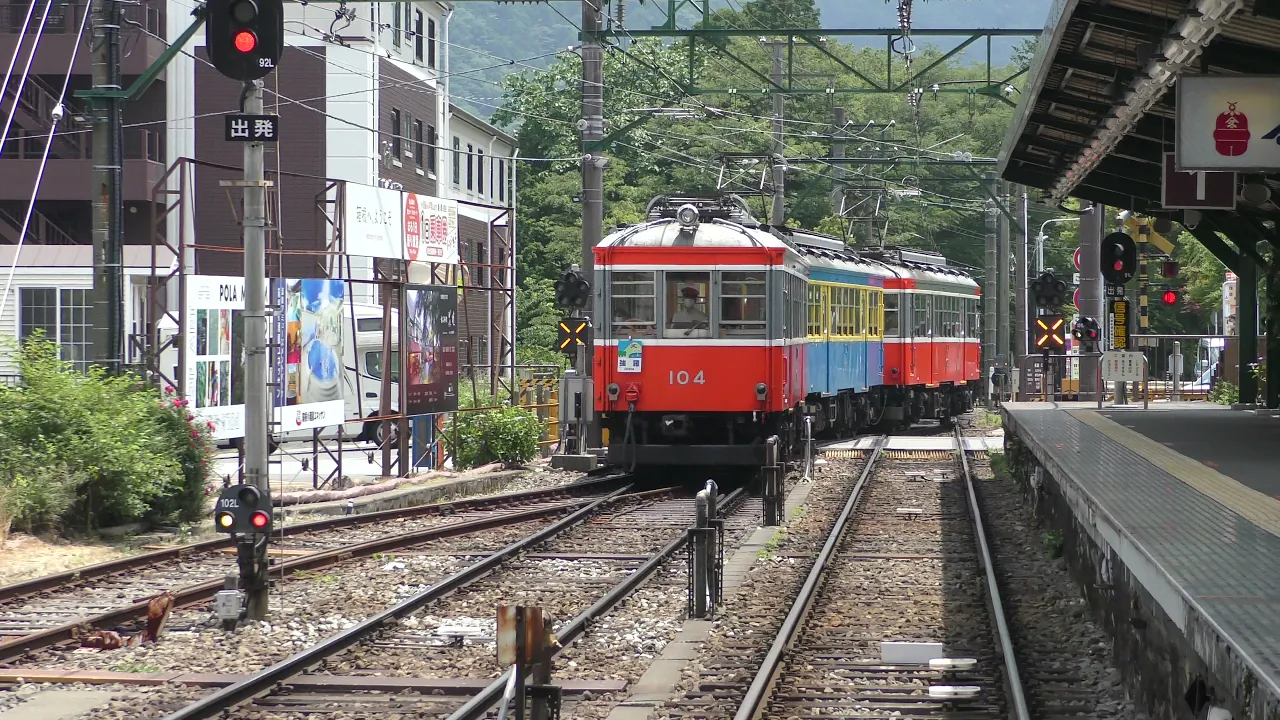
Odakyu Electric Railway, the owner Odakyu Hakone railway (formerly known as Hakone Tozan Railway) has announced that it will introduce new trains in fiscal 2028 (April 2028~March 2029).
The Hakone Tozan railway is a mountain railway with a number of switchbacks and lots of tight curves, so its trains carry water tanks to spray on the track to avoid overheating. The mountainous section (Hakone Yumoto~Gora) is standard gauge
Hakone Tozan railway has recently retired it 100 series trains that date back to the 1950s, but many of its other trains date back to the 1980s and the youngest trains were introduced in 2014.


The new trains will be designated 4000 series and according to Odakyu will have a streamlined face, the first for Hakone Tozan Railway. They will have large windows and angled seats so that riders can better enjoy the Hakone scenery. The trains will be 3 car fixed units.
Odakyu Hakone Press release: Click here (Japanese)

Hakone Tozan Railway gets crowded with tourists but it is a railway worth visiting by rail enthusiasts. Gora, Ohiradai (switchback) and Tonosawa are good places for photography and videos. There are also a number of bridges and level crossings that afford interesting photo spots.

JR Tokai to introduce compartments and semi private premium seats on the Tokaido Shinkansen.
JR Tokai is planning to introduce private compartments on the Tokaido Shinkansen~Sanyo Shinkansen (Tokyo~Osaka~Fukuoka) from October 2026 on some of its N700S series trains.
Selected trains will have lockable compartments, one for single travellers and one for two people. Each compartment will have WiFi, adjustable lighting and reclining seats with leg rests.


JR Tokaido will also introduce semi private premium seats during the 2027 fiscal year (April 2027~March 2028). these seats will be on par with JR East’s Gran Class.
Of course both the compartments and premium seats will command higher fares, which have not yet been decided / disclosed or what premium services will be provided. JR Tokai no longer sells drinks and other refreshments on the Tokaido Shinkansen (although the service still exists on Nozomi trains on the Sanyo Shinkansen.
Quick News Items
Seibu, Tsukuba Express & Nishitetsu to raise fares in March.
Seibu, Tsukuba Express in the Kanto region and Nishitetsu in Kyushu will raise fares on may 14th.
- Seibu will raise fares by an average of 10.7% with minimum fare rising to ¥170 (¥169 with IC card)
- Tsukuba Express average fare increase 12.2%. Minimum fare ¥180 (¥180 with IC card)
- Nishitetsu average increase 12.4%. Minimum fare ¥180 (IC card ¥180).
Higher costs are blamed for the increases but also delays in major repairs that have accumulated particularly due to delays cause by the pandemic.
Toyama tram derailment

On the 24th January, during severe weather (heavy snow fall and freezing temperatures) a 2 car tram derailed (MLRV 1000 series). Fortunately no passengers were on board the Man’yo sen tram in the city of Takaoka, Toyama Prefecture. The police and company officials are investigating the cause.
Moka Railways DE10 DL out of service – all SL Moka services been cancelled up to April and then to March 2027

As reported in our November edition, Moka Railway had already announced that it would be suspending all SL Moka services from April 2026 and March 2027 whilst its SL C12-66 undergoes its major inspection and repairs, the company had to announce that all SL Moka services between January and March 2026 have had to be cancelled due to damage to one of Diesel locomotive DE10 1535’s bogies. Normally DE10 1535 assists C12-66.
Moka Railway has said that repairs will be carried out to the diesel locomotive during the time that SL C12-66 is undergoing inspection / repairs and it still expects SL Moka services to restart in April 2027.
JR East 253 series Limited Express trains to get a new livery
JR East’s 253 series Limited Express was introduced in 1991 for the new Narita Express service following the opening of the rail link directly into Narita Airport.
They were all withdrawn from the Narita Express service in 2009-10. 2 units however were refurbished and put into service on the joint JR / Tobu Tokyo area~Tobu Nikko / Kinugawa Onsen service, replacing JR 485 series trains that were being used.
Despite the trains now being 35 years old they are going to be refurbished and given a new livery.
The refurbished trains will be introduced in June 2026


New exterior livery (JR East Image)
Maglev construction dispute between JR Tokai and Shizuoka Prefecture settled
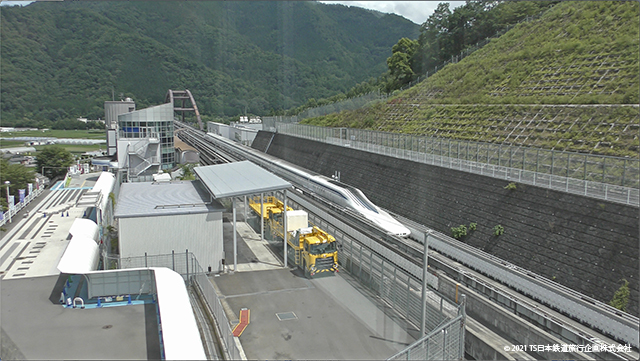
The long running dispute between JR Tokai and Shizuoka Prefecture over water resources from the Oigawa River was settled on Saturday 24th January.
Shizuoka Prefecture had refused to give permission for the construction of the Maglev through part of the procedure because of concerns over the water levels in the Oigawa River would become lower during the construction. The Oigawa River runs through an important tea growing area in the prefecture which requires a plentiful supply of clean water. The river also supplies drinking water to much of the prefecture.
The agreement reach means that JR Tokai will compensate the prefecture for any impacts that construction causes. The dispute has been running for 10 years.
Although this dispute was a major reason for the delay in the planned opening date of the line from 2030 to “at least the late 2030s” many major construction challenges still need to be overcome. Much of the line will be in tunnels under the Japan Alps. Another issue is the increase in construction costs.
Unlike other major rail construction projects in Japan, the Maglev Chuo Shinkansen construction is being led and financed by JR Tokai and not the government, although JR Tokai does have substantial preferential loans from the central government.
Yomiuri Shimbun English Japan News article https://japannews.yomiuri.co.jp/business/companies/20260125-306470/