Introduction
Welcome to the March 2026 TS Japan Rail Japan Rail Enthusiast Magazine.
As I am writing this, the Sakura in Tokyo is in bloom…I personally find the time just after the Sakura bloom to be the best, then you have a multitude of spring colours, pinks, reds and various shades of green. Travelling on local railways in Japan and seeing the mountains and valleys with all these colours is something else!
Back to trains and railways… I have just got back from a 670km local train ride using the JR Seishun 18 Kippu (literally “Youth 18 Ticket) which despite its name does not have an upper age limit and is popular with local enthusiasts. The conditions of usage for this ticket were changed in 2024 so we ask Is the Seishun 18 Kippu still a good ticket? we discuss this below.
We have also listed up which SL services will be operating this season…unfortunately it is much fewer than we would have liked. On the good side, C57-1 known as “The Lady” is expected to return to service on the SL Yamaguchi later this year.
There is a new site in Tokyo, which is going to attract rail enthusiasts “The Oimachi Tracks” 大井町トラックス, a development by JR East that includes shops, restaurants, a hotel and cinema….and being right in front of the Yamanote Line Oi Depot. (Even the hotel is advertising its view of the depot as one of its highlights!
Stephen Turner
JR East “Kairi” to do an overnight trip between Niigata and Tokyo Ueno

As part of JR East’s “Yamagata Shonai Summer Tourism Campaign”, the tourist train “Kairi” that operates between Niigata and Sakata, will do a special “Moonlight Kairi” (月 光
海里) service on the 15th & 16th May. On the 15th May it will run from Ueno to Niigata and return the following night.
In times past “Moonlight specials” used to operate on holidays (including one between Sakata and Shinjuku called the Moonlight Dewa ムーンライト出羽) which were overnight trains usually with normal seating.
The Moonlight Kairi will be operated by the HB-E300 Kairi train (pictured). It will run via the Takasaki Line and Joetsu Line.
The train will operate as a charter train (so normal fares / tickets do not apply) and all seats are reserved.
For details click here (Japanese) The Kairi Train will be at Ueno for publicity events on the 16th May.
We have an article on the tourist train “Kairi” on our main website Tourist Trains – “Kairi” Niigata~Sakata (Yamagata Shonai)
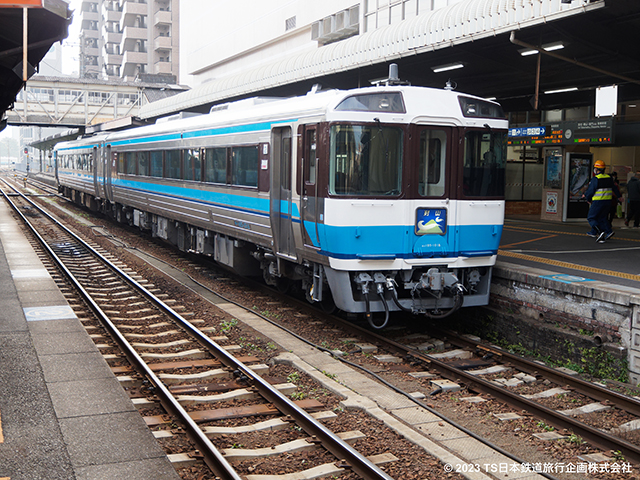
Two JR Shikoku KiHa185 units (Limited Express DMUs) moved to JR Kyushu to be used on the Limited Express Yufu service
Two JNR era Limited Express KiHa Diesel units have been transferred to JR Kyushu, reportedly to bolster services on the tourist popular Kyudai Main Line which links Kurume (with thru / connecting services to Fukuoka) and Oita via Yufuin.
The KiHa 185s have been used by JR Shikoku for limited express services. The two units 1016 & 1017 have become surplus to JR Shikoku’s requirements with the reduction in limited express services and the introduction of more efficient 2600 and 2700 series.
The KiHa185 was the last limited express train to be introduced by the Japan National Railways. Initially they were all allocated to Shikoku, although subsequently some were transferred to Kyushu, mainly for use on the Kyudai and Hohi Main Lines.

JR East has developed a new Damper for shinkansen trains that cuts lateral movement and reduces risk of derailment during earthquakes.

JR East has developed a new damper that reduces shinkansen lateral movement in case of earthquakes. Although trains, particularly shinkansen and limited express trains are fitted with lateral damping devices, these are primarily designed for passenger comfort.
The new damper developed by JR East is as a result of work done by JR East in collaboration with the Railway Technical Research Institute, following the Chuetsu Earthquake in 2004 when a 200 series shinkansen on the Joetsu Shinkansen derailed, due to excessive lateral movements.
Since then shinkansen tracks have been fitted with guard rails to minimise the risk. The new damper system is said to reduce the risk of derailment by around 50% (in the event of an earthquake of a similar strength to the Chuetsu Shinkansen.
During certain earthquakes there is excessive lateral movements that cause vibrations through the car body, ultimately leading to the car wheels to lift from the track and potentially derail. The new damper reduces the vibrations thus reducing the risk of the wheels lifting off the track.
It has been tested on the experimental Alpha-X shinkansen and JR East plans to fit the new system to its E5, E6, E7 & E8 shinkansen trains from 2027 through to 2032.
Further information click here (JR East News Release – Japanese)
Japan Steam Locomotives – 2026 Operations


| SL Name | Operation start date | Operation end date | Notes |
| SL Yamaguchi (JR West) | 2-May-2026 | not announced, no services in September October~November to be announced | weekends and holidays |
| SL Gunma Minakami / SL Gunma Yokokawa (JR East) | due to locomtive trouble, all spring services will be hauled by GV-E197 not SL. Date that SL services will start is unknown | Not announced (usually November) | some services will be operated using retro carriages. operates weekends and holidays. (see above for GV-197 picture) |
| SL Banetsu Monogatari (JR East) | 11-April 2026 (subject to confirmation) | Not announced (usually November) | on 11th April service will only operate one way (Niitsu->Aizuwakamatsu) and on 12th April will return to Niitsu. |
| SL Paleo Express (Chichibu Railway) | 20-Mar-2026 | 6-Dec-2026 | mainly weekends and holidays |
| SL Moka (Moka Railway) | No service in 2026 | No service in 2026 | Due to heavy maintenance no services until April 2027 |
| Oigawa Railway | no “Black SL” operating until 2028 (when Oigawa main line expected to fully reopen) | “Thomas the tank engine” days will operate. Check Oigawa Railway website | |
| Tobu SL Taiju | operates most days throughout the year | basically operates everyday between Shimoimaichi & Kinugawa Onsen and some days via Tobu Nikko | |
| SL Fuyu-no-Shitsugen (JR Hokkaido) | Operates January and February | ||

SL Yamaguchi C57-1 “The Lady” to re-enter service Autumn 2026
After suffering a major failure in 2020, SL C57-1, the first class C57 locomotive built in 1936, it has been announced that the locomotive will return to service in Autumn 2026. exact details have not yet been announced.
The locomotive has been at Umekoji, the depot attached to the Kyoto Railway Museum and the listed depot for all JR West’s steam locomotives, since 2020 and many of us wondered whether it would ever leave there under steam.
This is particularly good news as at the start of the 2026 season we have a number of steam locomotives out of action, or to put it another way, not so many running.
Seishun 18 Kippu – is it a good ticket for rail enthusiasts?
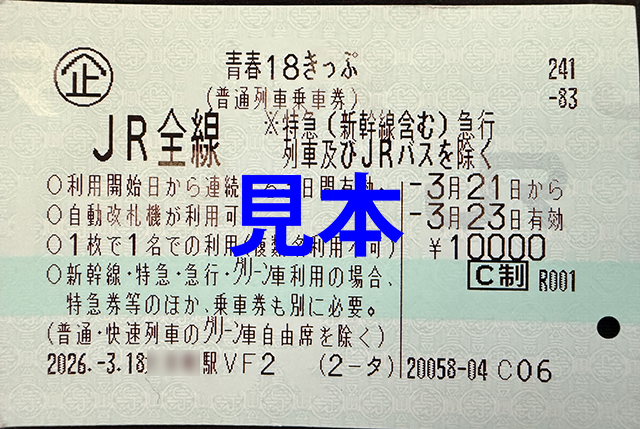
In past articles we have talked about the Seishun 18 Kippu. Seishun means youth as the ticket was designed for students for travel during college holidays. Interestingly though you do not need to be a student or a youth to use this ticket. In fact it is popular with retirees.
The Seishun 18 Kippu allows unlimited travel on all local and rapid trains operated by the JR companies throughout Japan.
The way the ticket works changed for the 2024/5 winter ticket, partly to make the ticket readable by ticket machines.
Here is a summary of the changes:
- Ticket was previously available for 5 non consecutive days (during the overal validity of the ticket) but this has since changed to consecutive days.
- The ticket was transferable, so for example it was allowable that different people used it on different days, or instead of 5 days of travel it could be used by 5 people for 1 day of travel or any combination. Now the ticket can only be used by 1 person.
- A three day ticket was introduced at a cost of ¥10,000 in addition to the 5 day ticket (¥12,050)
- The tickets became machine readable (actually the reason for the first two changes above), you are no longer required to get the ticket stamped on each day you use it.
- You can now buy the tickets from the Limited Express / shinkansen ticket machines (previously you had to go to a ticket office)
So is the ticket still worthwhile?
As we tell everyone using a free pass type ticket, it 100% depends on your itinerary, but here are some things to think about:
- for the 3 day ticket you need to travel around 600km~650km to break even (the amounts vary as JR East and JR Shikoku have their own slightly higher fare scales). It is possible to travel this distance in 3 days using local / rapid trains, but you will be travelling most of the time. This may not be an issue for a rail enthusiast, but if you want to include some culture in your trip, you may be limited.
- For the 5 day ticket you need to travel 880km~920km in 5 days to break even (again distance varies for the same reason above). This is a bit easier than the 3 day ticket, as it reduces the daily average of distance you need to travel.
- What we have found is that although the distances are achievable (for rail enthusiasts) the loss of flexibility due to the ticket only being valid for consecutive days, you are more likely to have to use the pass in conjunction with other tickets, again more so with the 3 day pass. You are less able to maximise the distance travelled, particularly if you spend days with more non JR rail travel.
Conclusion
In conclusion, we would say that to get the maximum out of these tickets you need to plan your routes more carefully. The 5 day ticket is easier to get maximise the value you get out of the ticket, the 3 day ticket, although you can break even +/- a little you may find it more difficult to maximise value in the same that you can do with the 5 day ticket. In both cases they are not so good as the old non consecutive 5 day tickets.
For rail enthusiasts however, they may be worthwhile if you are planning to travel on many local lines. TSJR does a lot of local train travel, so we do find these tickets useful, although not as much as before. This ticket is probably of less use to those who want to Explore Japan by Train and include stop offs on their journey.
When can you use these ticket
Please check the exact dates as they are fixed each year but generally the tickets are available;
- Spring: all of March through to around 10th April
- Summer: Mid July through to around early September
- Winter: Mid December to 2nd week of January
TS Japan Rail’s Itinerary Planning Service & Full Travel Planning Services includes recommending best tickets to use for your itinerary. For Rail Enthusiasts we can also devise interesting itineraries using the Seishun 18 Kippu ticket either exclusively or in combination with ordinary tickets or other passes (in some cases this may make sense for those wanting to Explore Japan by Train).
New Shopping and hotel complex to open with a great view of the Yamanote Line Depot…


The main Yamanote Line depot is based at Oi in Shinagawa-ku Tokyo. It is next to the large Tokyo Rolling Stock Maintenance Works. On what used to be JNR / JR East apartments for railway staff a new complex that includes shops, restaurants, hotel and a cinema has been built and will be opened on March 28th 2026.
The complex which is run by JR East is called Oimachi Tracks and is close to the Oimachi JR, Tokyu and Rinkai Line stations. It has a great view of the Yamanote Line depot (hence the name). In fact the hotel (JR Hotel Metropolitan Oimachi) is advertising itself to rail enthusiasts because of the view!
Freight update – new timetable


The new JR Freight timetable was published in March. Although no major changes to schedules, there has been some reconfiguration of services to boost capacity. In fact with the tighter restrictions on truck drivers hours and generally shortage of truck drivers, rail freight has seen some pick up in business, although may be not as much or not as fast as hoped for.
Quick summary of changes:
- Tokaido Main Line Tokyo~Osaka reconfiguration of four overnight trains from Tokyo to Osaka is increasing capacity from 340 units to 475 units on these trains.
- Tokaido Main Line / Sanyo Main Line / Kagoshima Main Line Nagoya~Fukuoka Capacity between Nagoya / Gifu and Fukuoka has been increased from 120 units to 150 units by reconfiguring two train services on these services
- Tohoku Main Line / Tokaido Main Line Sendai ~ Tokyo / Nagoya / Osaka reconfiguration of a number of services has doubled the capacity on this route, particularly between Sendai ~Tokyo and Nagoya. This has partially been achieved by adding a new service in each direction between Sendai and Utsunomiya that allows for better (faster) connections.
- New service between Niigata~ Osaka. A new daytime service between Niigata / Minami Nagaoka and Osaka will add an extra 100 units on the Japan Sea Route that links Kansai, Hokuriku, Chuetsu and Tohoku.
- There are also some other changes that add capacity to the network.
(*reconfiguration can mean changes to train length to increase capacity, timetable changes or minor route changes to make connections better, improve capacity and / or speed up end to end journey times)
Re-gearing of some EH500 locomotives so they can handle the Joetsu Line route

Another big change that has been featured in the railway press are changes that have been made to EH500 dual voltage locomotives that are primarily used on the Tohoku Main Line, but also with through services on the Tokaido Main Line.
At times when the Tohoku Main Line is unavailable, for example because of earthquakes, an alternative route linking Tohoku and Hokkaido with the Kanto area is via the Joetsu Line (Takasaki~Nagaoka) and Uetsu Main Line (Japan Sea Route).
The Joetsu Line however has some steep gradients, which the EH200 1500V DC locomotives were built to handle. However with only 25 of these locomotives available in times of extended disruption, there are capacity issues due to a shortage of locomotives.
Therefore JR Freight has been re-gearing some of its EH500 locomotives so, when needed, they can handle the Joetsu Line route. These regeared EH500s are not expected to be used regularly on the Joetsu Main Line / Uetsu Main Line, except for testing and driver training, but will be useful in times when the Tohoku Main Line is not available.
Interested in seeing Japan Rail Freight Operations? TS Japan Rail can help you with information on times, places and of course how to get the best places!
Breaking News – Kyushu’s Heisei Chikuho Railway to close all 3 lines and replace trains with buses
On the 25th March it was announced that the 3rd Sector Heisei Chikuho Railway (nickname “Heichiku”), that operates 4(*) lines in the eastern part of Fukuoka Prefecture will close and trains services will be replaced by community bus services. Agreement has been reached with local governments and others to proceed with the closure plan. Permission needs to be obtained from the Ministry of Land Infrastructure, Transport and Tourism (MLIT). Once this has been obtained and resources to operate the replacement bus services train services will end.
Heisei Chikuho Railway operates lines that it inherited from JR Kyushu in 1989. In total the company operates 49km of routes, all non electrified and mostly single line. The lines are:
- Ita Line (伊田線): 16.1 km, from Nogata to Tagawa‑Ita
- Itoda Line (糸田線): 6.8 km between Tagawa‑Gotōji and Kaneda
- Tagawa Line (田川線): 26.3 km from Tagawa‑Ita to Yukuhashi
(*)It also operates the 2.1km Mojikō Retro Kankō Line, which is a tourist line which it is not clear whether this line is included in the closures.
Although agreement to close the railway made, there are still challenges…..
There is still a major challenge. Heisei Chikuho Railway also operates buses, but has had to reduce its bus network due to a shortage of bus drivers. Whether the company, or an alternative operator can secure the estimated 44 drivers that will be required to operate the new bus services is unclear.
Therefore the actual date of closure is still far from clear as it is dependent on alternatives being put in place. This is particularly important as the railway serves students going to 12 high schools, 4 vocational schools and colleges, and 1 university, and it is estimated that 40% of students to these institutions commute by Heisei Chikuho trains.
Recent posts of interest to rail enthusiasts
This site

TSJR Main Site