

Introduction
Welcome to our June 2026 Japan Rail Enthusiast Magazine. It has been a busy few weeks here at TS Japan Rail. We recently finished an 18 day rail enthusiast tour with rail fans from UK, US and Australia. There is a quick summary of the tour later in this magazine
In this month’s article:
- Find out who are this years winners of the Japan railfan Club’s prestigious Blue ribbon and Laurel awards and the awards are determined...
- learn the latest on JR East’s night express “Luna Azul”
- the end of magnetic backed train tickets comes a step closer…
- JR East’s plans for train autonomous operation
- rolling stock and other news
Planning a rail enthusiast group tour to Japan, you can also read and see more on why partnering with TS Japan Rail can make your tour more of a success
If you have any questions on these or other Japan rail matters please feel free to ask!
Read on for more….
Stephen Turner
2026 Blue Ribbon and Laurel awards for best new trains entering service in 2025

These are prestigious awards in the Japan rail industry awarded by the Japan Railfan Club (JRC 鉄道友の会). The Japan Railfan Club is the largest rail enthusiast association in Japan, with more than 3,000 individual members and a many major rail companies and railway related companies as corporate members.
How are the awards decided?
The Blue Ribbon award is for the best rolling stock that entered service in the previous year, and the Laurel Award is for excellent rolling stock that entered service the previous year. The selection for both awards is done together in a 2 step process.
Firstly a selection committee made up of senior JRC members who are experts on rolling stock compile a short list. this short list usually consists of passenger trains, but occasionally, as it happened in the 2026 selection, freight cars make it onto the list. The second stage is a vote by the individual members of JRC.
The train / car having the most votes gets the Blue Ribbon award and the the two trains / cars with the 2nd and third highest number of votes get the Laurel Award.
…and the 2026 awards
Blue Ribbon: Keifuku Electric Railway (Randen Tram) MoBo 1 Series

Introduced in February 2025 on the Kyoto Randen Tram, it is described as “new type of tram” that transcends time, with its traditional rounded front and sides and roof with a modern design. The traditional and modern also come together with its wood grain finish, monochrome sides and ceiling and led lighting and information displays. The seating and handrails are designed for comfort.
The outside and seating are coloured in Kyoto Purple, the traditional Randen livery.
The train is fitted with hybrid SiC VVVF and regenerative braking resulting in 50% reduction in power consumption compared to older rolling stock.
Laurel Award: Tobu 8000 series
The Tobu 80000 series 5 car units are being introduced on to the Tobu Urban Park Line in Saitama Prefecture.
These trains will help Tobu reduce its CO2 emissions by 50% by 2030, as well as being more family friendly and accessible (barrier Free)
On the technical side the train is fitted with full SiC VVVF inverters to increase power efficiency and also auxiliary power generators which are charged using regenerative power. The trains also have state of the art monitoring of systems and operations. Although not fitted the trains have room for track, signalling and overhead wire monitoring.

Laurel Award: Iyo Tetsudo 7000 series

The Iyo Tetsudo based in Matsuyama Ehime prefecture operates 3 heavy rail lines (and Matsuyama trams), all using 600V DC power.
the 7000 series units are the first completely new trains purchased by Iyo Tetsudo since 1958.
These trains are designed to improve passenger comfort (air spring suspension, large windows, LCD information screens) barrier free, and big improvements in energy efficiency (IGBT element VVVF inverters, regenerative braking. Maintenance is also very much reduced.
The 7000 series is described as having a simple but futuristic design.
For more information see the JRC website https://www.jrc.gr.jp/e/award/bl/bl2026
JR East announces details of its new Night Express “Luna Azul”

As previously announced JR East is converting one of its dual voltage E657 Limited Express electric units to a special night express. The train has been named “Luna Azul” )Azul is Spanish for blue) with the idea that the train will bring back the feel of the old blue sleeper trains.
The train will operate two routes:
- Spring~Autumn overnight service between Shinagawa and Aomori via the Joetsu Line and Uetsu Main line (Japan Sea route). Journey time 12~15 hours. There will be 2 return services a week. Capacity 125 people
- Winter day time service between Shinagawa and Naganoharakusatsuguchi (gunma Prefecture for Kusatsu Onsen) via the Takasaki Line and Agatsuma Line. Journey time 2 1/2~3 hours. There will be 6 return services a week. (only 7 cars will be in use) Capacity 150 people
The train will be made up of 10 cars or 7 cars (for winter service), all of which will be Premium Green or Green Cars with private compartments. The cars are as follows:
| Luna Premium | Premium Green Private Compartment (for 1 person on evening services, 2 people on daytime services) | Car 1 | approx. 110 cm wide × 190 cm long |
| Luna Premium Wide | Premium Green Private Compartment (for 2 people on evening services, 4 people on daytime services) | Cars 1 & 10 | approx. 200 cm wide × 190 cm long |
| Luna Comfort | Green Private Compartment (for 1 passenger during night services, 2 passengers during daytime services) | Cars 2,3,6,7,8 & 9 (cars 8 & 9 not used during winter service) | approx. 90 cm wide × 195 cm long |
| Luna Comfort Wide | Green Private Compartment (for 2 passengers on night services, 4 passengers on day services) | Cars 4,6 & 7 (car 4 not used during winter service) | Approx. 185 cm wide × 200 cm long |
| Luna Comfort Grande | Green Private Compartment (for 4 passengers on night services) | Car 4 | Approx. 325 cm wide × 195 cm long |
| Lounge | Car 5 | (will include drinks & snacks counter) |
The train will not have sleeping berths, but seating and / or carpeted area to sleep or sit.
Fares: Not yet fixed but for the Tohoku service it is expected to be around the Green class fare of the shinkansen (Tokyo~Shin Aomori) plus a supplement depending on the type of accommodation.
Service is due to start during fiscal year April 2027~ March 2028.
Aomori service
For the service from Tokyo, departure time will be around 21:00 and it will arrive at Aomori around 9pm. That means the best place to see the train in daylight will be in Tohoku, north of Sakata on way to Akita (Uetsu Main Line) and between Akita, Hirosaki and Aomori on the Ou Main Line.
In the reverse direction (to Tokyo) the train leave Aomori at 16:00, so should be visible in daylight along the Ou Main Line and early morning along the Eastern end of the Joetsu Line and along the Takasaki and Utsunomiya Line. The train arrives at Shinagawa at 7am.
Gunma Kusatsu Service
As this will be a day time service it will be seen through out its route. The best locations will be the stations it passes through on the Takasaki and Agatsuma Lines.
When the full schedule is announced we will of course provide more information
JR East Press Release (Japanese) https://www.jreast.co.jp/press/2026/20260609_ho04.pdf
It is expected that this train will be very popular and tickets will need to be booked well in advance. JR East has not yet specified how tickets can be booked.
JR Tokai announce details of it Supreme Class Cabins to be introduced on the Tokaido・Sanyo Shinkansen services in October 2026
JR Tokai has announced details of its premium compartments or “cabins” as they will be called that will be introduced on some trains from October 2026. Under the branding “Supreme Class”, the compartments will be introduced on N700 Supreme class shinkansen models. Semi Private Premium seats will be introduced during 2027.
There will be two cabins on specified trains, one in car 7 which will be sofa type and can accommodate 2 people and 1 on car 10 that can accommodate 1 person. (later (2027) car 10 will have 6 semi private “supreme” seats added.

These seats will not be cheap! for the 1 person cabin in car 10, the cost will be ¥42,100 (for those using the business version of smart-ex) compared to ¥19,390 for a mid week Green Class ticket between Tokyo and Shin Osaka. The larger Car 7 cabin is even more expensive at ¥60,500 (however a guest can travel with the person using a normal unreserved, reserved, green car ticket for the journey undertaken).
The initial Supreme Class Cabins in cars 10 & 7 will use existing spaces such as where the smoking rooms were located and other spaces that were not used for passenger seating. When the semi private Supreme Seats are fitted there will be a small reduction in the number of Green Seats available in Car 10. Except at very busy times, e.g. New Year, Golden Week and Obon, the impact will be minimal.
JR Tokai press release (Japanese) https://jr-central.co.jp/news/release/_pdf/000045683.pdf
JR East announces end of magnetic backed tickets for short journeys in greater Tokyo area
From the start of the 2027 fiscal year (March 2027~) JR East has announced that the traditional magnetic backed tickets will be phased out and instead will be replaced by QR code tickets that will be scanned rather than feeding the ticket into the ticket gate.

The size of the QR tickets will also be increased to make them easier to scan. Current size local travel tickets are 30×57.5mm, the QR code tickets will be 57.5x85mm to make it easier to scan them.
The magnetic backed tickets cannot be recycled, whereas the QR cod tickets which are just paper tickets can be. Also as the tickets just need to be scanned, ticket gate mechanical breakdowns and general maintenance should be reduced.
For Limited Express, shinkansen and tickets for journeys over 100km will, for the time being, continue to be magnetic backed tickets. JR East will reorganise the positions of ticket machines categorised for local trips and other trips to make it easier for passengers. In reality, the number of physical tickets issued for local train journeys has been in decline since the introduction of IC Cards.
Many, particularly smaller, non JR rail companies have been introducing QR code tickets as a means to save money (both the tickets themselves and ticket gate maintenance are cheaper.
JR Tokai to run overnight shinkansen as experiment on 8th August 2026
JR Tokai has announced that it run an overnight shinkansen service on the Tokaido Shinkansen line from Tokyo to Kyoto and Shin Osaka. This train is being run as an experiment to see how popular a regular service may be. The train will operate on the 8th August 2026 (Saturday) arriving the next morning.
The train will leave Tokyo at 22:00 and call at Shinagawa and Shin Yokohama. It will arrive at Gifu Hashima at around midnight where it will remain until about 6:00. For half an hour after it arrives and 30 mins before it departs Gifu Hashima the doors will be opened to allow passengers to use vending machines etc, but will not be able to exit the station. At other times the doors will be closed.
There will be a women only car (patrolled by train staff)
The train will arrive at Kyoto at 6:44 and Shin Osaka at 6:59, on the 9th August 2026.
The last regular train from Tokyo to Shin Osaka leaves at 21:24.
Only window seats will be available (seats A and E in ordinary class and A & D in green car). Fare is expected to be around ¥15,000. Seats will have to be booked in advance (booking site URL in press release: https://jr-central.co.jp/news/release/_pdf/000045694.pdf
Quick News
Tokyo Metro Line goes fully to One Man Operation
Tokyo Metro’s Ginza Line, the oldest subway line in Japan, has gone completely to one man operation. This follows completion of modifications to the lines 1000 series trains and fitting of platform doors and sensors to all 19 stations on the line. This move is significant considering the high frequency of services on the line. The Ginza Line is however the only one of two line subway lines that operates with only one type of train, all of which are the same length (6 cars) with no in service through running with other lines (the other line being the Marunouchi Line).
Tokyo Metro upgrading “Tap to Pay” scanners
Tokyo Metro is upgrading its ticket gate “tap to pay” and “QR Code” scanners to speed up the flow of people through these gates. New equipment is being retrofitted into the former housing of Toshiba and Omron scanners. Tokyo Metro has also started a publicity campaign to get more people to use tap to pay and QR codes. Local travellers however have a strong preference to using the transportation IC cards and tap to pay in particular is more popular with inbound tourist visitors.
Seibu have introduced their “new” 7000 series trains

Former Tokyu 9000 series trains acquired by Seibu will debut on Seibu lines as Seibu 7000 series trains on 27th June. Th efirst converted train was revealed to the public a Seibu’s Train Festa on June 6th.
As part of Seibu’s efforts to employ more efficient trains across its network, it has acquired some of Tokyu’s 9000 series trains (formerly Toyoko Line and latterly Oimachi Line) to use on its non mainline lines.
The trains have had much of their electrical equipment replaced with more energy-efficient VVVF inverters and the interiors have been updated.
The initial converted train will debut on Seibu’s Sayama line.
Odakyu Hakone (Hakone Tozan) to retire its 100 series trains in January 2028
Odakyu Hakone has announced that its historic 100 series trains will be retired in January 2028.
MoHa1 unit 104 & 106 and MoHa 2 (108) (single car unit) are popular with rail enthusiasts and usually seen operating as a single formation. The MoHa1 units date back to 1919 although they were substantially rebuilt in 1950 when their wooden bodies were replaced with steel bodies and other modifications were made (and since then). All three units however retain their Showa era wooden hand painted interiors, wooden windows and traditional luggage racks.

Odakyu Hakone will have numerous events celebrating these trains up until 2028. [Note Hakone Tozan Railway which has been part of the Odakyu Group since 1948. A reorganisation of the Odakyu Group in April 2024 saw the Tozan Hakone Railway renamed as the Odakyu Hakone Railway (小田急箱根鉄道), although many people still know it as the Hakone Tozan Railway).
Amagi Railway new ARe500 Series DEMU

Continuing the trend of smaller railways opting for more efficient new trains rather than buying second hand trains from the larger rail companies, third sector, Fukuoka Prefecture based Amagi Railway has introduced its new ARe500 series DEMU. the new diesel cars will eventually replace Amagi’s 8 older railcars. The ARe500 is the company’s first new rail car in 20 years.
Kita Osaka Kyuko to retire its remaining iconic 7000 series “Polestar” “trains.
With nearly 40 years of service, Kita Osaka Kyuko will retire its 8000 series Polestar trains soon.
The kita Osaka Kyuko Railway company operates one relatively short, 8.4km, line that links residential areas in norther Osaka with the Osaka Metro Midosuji Line.

Ichibata to retire is 5000 series trains

Ichibata Dentetsu in Shimane Prefecture has announced that it will be retiring its last remaining 5000 series train. the 1967 era train started life on the Keio Inokashira Line.
Like many smaller private railway, Ichibata or Bataden as it is known locally, is using government subsidies to upgrade their fleet with new more efficient trains and the 5000 series unit will be replace by the new Bataden 10000 series train.
Technology has moved on so that new electric trains can operate on around 50% less energy than train built in the 1960s,70s & 80s.
JR East updates time line for shinkansen autonomous operation.
JR East has updated its plans for shinkansen autonomous driving:
- FY 2028: Introduction of GoA2 (automated driving with driver on board for stopping and starting train) for passenger trains between Nagaoka and Niigata.
- FY 2029: Introduction of GoA4 (Unattended Train Operation). This will be strictly for “deadhead” (out-of-service/empty) trains traveling the 5.1 km stretch between Niigata Station and the Niigata Shinkansen Rolling Stock Center. There will be absolutely no crew on board for these depot transfers (testing for this between Niigata Station and Niigata Shinkansen Depot is completed, currently JR East is refining software as a result of the testing.
- Mid-2030s: The major milestone. JR East plans to achieve GoA3 (Driverless Train Operation with an attendant) for passenger-carrying Shinkansen trains between Tokyo and Niigata. Currently trackside equipment is being installed along the Joetsu Shinkansen route.
- After the Joetsu Shinkansen, JR East, together with JR West who operate the western end of the Hokuriku Shinkansen plan to do similar roll out (GoA4 for deadhead runs and GoA3 for passenger services). JR West is currently carrying out its own autonomous train operation.
(note both routes use the E7 (JR West W7) shinkansen)
JR East is planning for the Keihin Tohoku Line and Yamanote line to introduce GoA2 automated driving with driver on board for stopping and starting train from 2027. The current plan is for the Yamanote Line to be GoA3 Driverless Train Operation with attendant from 2035. This means that the an attendant rather than a fully qualified driver will be on the train (and the only staff member on the train).
JR East is also busy preparing for one man operation on the Yamanote and Keihin Tohoku Lines with E233-1000 and E235-0 units having their cabs fitted out with CCTV and other required equipment. The plan is for the Keihin Tohoku Line to start one man operations on the sections between Omiya & Minami Urawa and between Kamata and Ofuna in spring 2027 and the whole line in 2030. The Yamanote Line will switch to one man operation in 2030.
Currently the following routes have or are employing GoA2 automated driving with driver on board for stopping and starting train:
Spring 2025:
- Joban Line (Local Service between Ayase and Toride)
- Nambu Line (Between Kawasaki and Tachikawa)
Spring 2026:
- Yokohama Line / Negishi Line (Specifically 8-car trains operating between Higashi-Kanagawa/Hachioji and Ofuna)
2030s:
As well as the Keihin Tohoku Line and Yamanote Lines, the Chuo-Sobu Line Local Trains & the Saikyo & Kawagoe Lines are also expected to switch to one man operation.
We can also expect a gradual role out of autonomous operations on these and other lines in the 2030s and beyond.
In future magazines we will take a look at what other railway companies are doing.
JR East 253 series new livery trains in service from 23rd June 2026
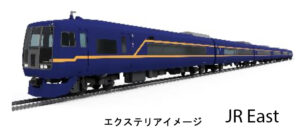
The blue liveried 253 series limited express train that is used on the JR – Tobu joint limited express service between Shinjuku ~Tobu Nikko / Kinugawa Onsen, which this year is celebrating its 20th anniversary. The 253 series was first introduced in 1990 for the then new Narita Express service.
TS Japan Rail Publicity time…..what we can organise for your rail enthusiast tour of Japan!
TS Japan has a good reputation for organising interesting and customised tours for international rail fans. We understand what rail enthusiasts want (many things for many different rail fans) and we can we build in some flexible.
We have organised Linesiding opportunities & depot visits; taken groups on lines only local know about and visited local rail enthusiasts.
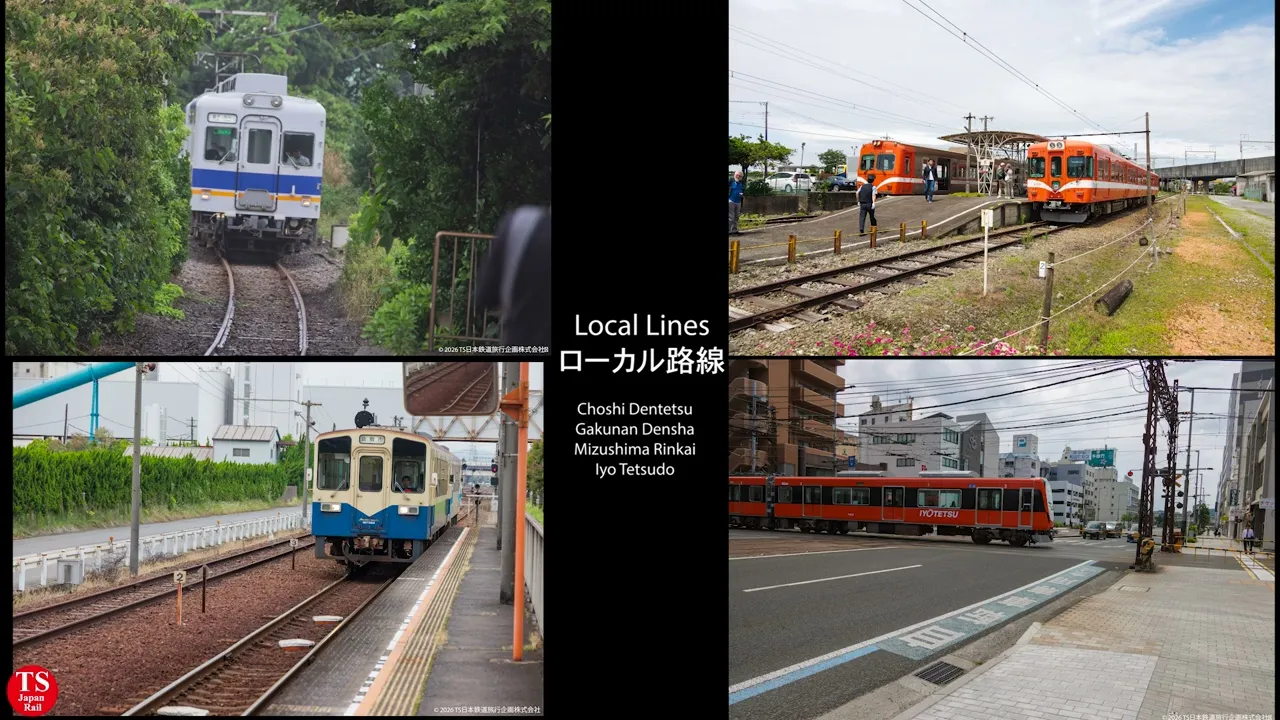

Our last tour, which included rail enthusiasts from UK, US & Australia, included:
- Steam Linesiding & riding; SL Paleo Express (Chichibu Tetsudo Saitama), SL Yamaguchi (JR West Yamaguchi)
- Trams; Hiroshima, Matsuyama, Kochi, Okayama
- Freight; Chichibu Tetsudo, Sangi Tetsudo, Mizushima Rinkai Railway, JR Kyoto Line -Yamazaki, JR Sanyo Main Line -Kurashiki, Onomichi,
- Other; Ashio Narrow Gauge Museum, Watarase Keikoku Railway, Tsuyama Railway Education Museum, Gakunan Electric Railway, Choshi Electric Railway, Shizuoka Tetsudo, Rasschijin Railway Society,
Participants also visited Kyoto Railway Museum, Omiya Railway Museum, SC Maglev & Railway Park and had a great time travelling on local lines as well as shinkansen.
Find out more: contact TS Japan Rail today


