Introduction
We have changed the name of this monthly newsletter to Japan Rail Enthusiast Magazine. We also apologise for being a bit late this month. These monthly updates have proved more popular than we anticipated. We thank everyone for reading them. Please let us know if you have comments or ideas on other items that you would like to see mentioned and we will try to include them in future.
In this month’s edition we have items on a rare collision and derailment, the Yamanote Line 100th anniversary, the growing problem of animal collisions as well as a new restaurant train to be launched by Seibu.
Yamanote Line 100th anniversary


The Yamanote Line will be celebrating its 100th anniversary on the 1st November. For those who do not know, the Yamanote Line is the famous railway line that circles the central part of Tokyo, joining Shinjuku~Ikebukuro~Ueno~Tokyo~Shinagawa~Shibuya and back to Shinjuku. It is estimated that several million (3 to 4 million) users use the “Yamanote Line corridor” every day (there are several lines that run parallel to the Yamanote Line in places such as the Keihin Tohoku Line, Saikyo Line, Tokaido Line and Shonan Shinjuku Line).
A quick history of how the Yamanote Line came about
Not so well known, the Yamanote Line was not built as circle but is an amalgam of several lines:
- Shinagawa Line 1885 connecting Shinagawa to Akabane via Shinjuku – connecting the modern day Tokaido Line at Shinagawa and the Modern day Tohoku Line at Akabane. Initially the main purpose of the line was for carrying freight (raw silk) from Gunma Pref to Yokohama.
- Toshima Line 1903 Ikebukuro~Tabata section.
- The Shinagawa Line and Toshima line were merged and renamed the Yamanote Line in 1909.
- The Shinagawa~Tokyo section opened in 1919 as part of the Chuo Line (Nakano~Shinjuku~Kanada~Tokyo~Shinagawa)
- The full loop was opened in 1925 (1st November) after the Tokyo~Ueno elevated section was opened.
The Yamanote Line is one of the busiest urban lines in Japan and plays an important part keeping th ecity moving. Any disruption can and does have a major impact on getting around the city.
Trains every 3~4 minutes during the morning rush hour
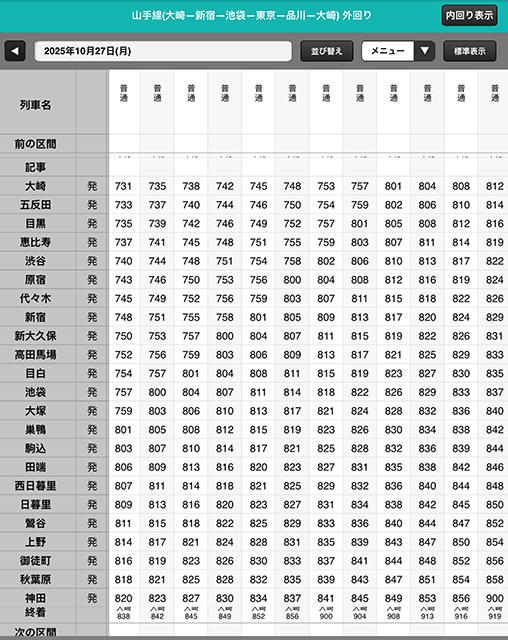
This is an extract of the Yamanote Line outer loop timetable between 7:30 & 8:12 on a weekday morning.
As you can see trains are running at intervals of 3 to 4 minutes.
Another important aspect of the Yamanote Line is the number of other JR and non JR lines it connects with, so as well as important business / leisure places along the route it also has many people changing trains along its route which also makes it very busy. Controlling the dwell times at stations is very important, so the old pictures of the Japan railways and staff pushing people onto trains, is not the norm nowadays. Instead you will hear announcements asking people to wait for the next train, which during the rush hour will be close behind.
To keep these schedules, the operation of the Yamanote Line is highly automated using ATC signalling with floating blocks, which allows trains to run closer together. Train maintenance is also very important and modern trains have a lot of built in monitoring.
Over the years rolling stock design has also improved increasing capacity, but also allowing fast boarding and de-boarding.
Large fleet of trains…
Today JR East operates a fleet of 50 eleven car E235 series trains dedicated to the Yamanote Line, which are all based at the JR East Oi depot and Ikebukuro sub depot.
This compares to 32 ten car 205 series and 24 103 series ten car units (total 56 units) in April 1986, but with higher frequencies nowadays.
Yamanote Line units were increased to 11 cars in 2002 when car an extra car was inserted in between cars 10 (driving trailer became car 11) and car 9 (trailer). Between 1990 and 2010 trains had 1 (205 series car 10) or 2 (231 series cars 10 & 7) cars with 6 doors (and less seating) to help reduce overcrowding in the rush hour. During the rush hour, the seats in front of the extra doors were mechanically moved so the extra doors could be used. At other times those seats were in place and those cars reverted to normal 4 door use. These were phased out in 2010 in order to make the installation of platform doors easier.
Programming error with ATC led to collision and derailment on Tokyu’s Denetoshi Line, causing major disruption.
On the Tokyu Denentoshi Line at Kajigaya Station in Kawasaki Station, and in service train heading for Shibuya in Tokyo had a slow speed collision with an out of service train just after 11:05pm on the 5th October 2025 (Sunday). The collision cause the rear car of the out of service train, which was on its way to stabling sidings at Kajigaya, to derail.
How it happened…
The out of service train was heading for stabling sidings just outside the station and was being driven by a trainee driver under instruction. The train was heading too fast and the ATC system (Automatic Train Control) bought the train to a stop.
The ATC at this point worked correctly, but left the rear coach of the train still on the main line. An in-service train approaching Kajigaya with a stopping service to Shibuya however did not get a ATC warning to stop / automatic stop as it approached the station platform. Fortunately the driver noticed that the out of service train was in the wrong place and still partially occupying the main line and could apply the emergency brakes, but was unable to stop in time leading to the collision. (picture credit: Tokyo Shimbun)

Fortunately there were no injuries amongst the 149 people on board the train or on the out of service train.
Major impact the following day….
It is estimated that around 650,000 passengers were effected between the time of the accident to when train services could be fully restored in the evening of the 6th October (Monday). Services were completely suspended on the Denentoshi Line between Saginuma and Shibuya and on the Oimachi Line between Mizonokuchi and Futako Tamagawa. Also on the Oimachi Line as most of its rolling stock is held at Saginuma & Nagatsuta depots (and some stabled at Kajigaya) so “stranded” by the accident, it had to drastically reduce services between Futako Tamagawa and Oimachi (only 30% of morning rush hour services could be operated) due to lack of available rolling stock.
ATC Programming error dates back to 2015 and similar errors have been found at three other locations
The error in the ATC programming, that should have provided a red signal to the driver in his cab, dates back to 2015 when work was carried out on the track layout at Kajigaya. Similar programming errors have subsequently been found at Futakotamagawa Station (effecting Denentoshi & Oimachi Lines) and Shin Yokohama Station (effecting Tokyu Shin Yokohama Line).
All the errors were fixed by 23rd October and until they were fixed speed restrictions were put in place at the affected stations.
The Japan Transport Safety Board and Tokyu are carrying out investigations to determine exact causes and importantly deciding on what improvements need to be made to avoid reoccurrence.
JR East’s Riku West Line (陸羽西線) to reopen on 16th January 2016

The Riku West Line that links (Sakata) Amarume and Shinjo in Yamagata Prefecture will reopen on the 16th January 2026. It has been closed since 14th May 2022 due to tunnel construction on a nearby national highway.
For much of its route, the Riku West Line operates along the Mogami River and has great scenic views.
Yamagata is not especially known for its railways, but it is interesting for rail enthusiasts who want to see rural and scenic lines.
Controversy – JR Freight is scrapping some historical locomotives it has in store…

JR Freight has announced that it will be scrapping a number of “historic” locomotives at its Hiroshima Depot. They are:
- Steam Locomotive D52-1 (this was the first D52 series SL built)
- Electric Locomotive EF67-105. EF67 were used as banking locomotives for the steep gradient on the Sanyo Main Line on the Senohachi section.
- Electric Locomotive EF200-10 JR Freights first DC inverter type locomotive
- Electric Locomotive EF500-901 prototype locomotive, dual voltage (1500V DC / 20KV AC) primarily for the Tohoku Main Line. Forerunner to EH500.
Also a チサ9000 (CHISA 9000) prototype flat wagon for testing Piggy Back truck transportation will be scrapped.
This has caused a lot of controversy amongst rail fans. Unlike the UK, there are not the heritage railways or individuals who preserve these historical locomotives and other historical railway items. This is mostly done by railway companies themselves or museums.
JR Freight is holding a final photo session on 1st & 2nd Nov (paid event that is already sold out).
Seibu to introduce a new restaurant train in 2028

Seibu Railway has announced that it will introduce a new restaurant train in March 2028. The train will be based on its “Laview” Limited Express train (001 series).
Although based on the Laview Limited express train both internal and external will be designed by renown architect and designer Kazuyo Sejima who received the Pritzker Prize in 2010.
The train will be 4 coaches in length and will include an onboard kitchen (car 3); Cars 1,2 & 4 will be for dining passengers including a private dining room seating 8 people.
The train will operate on Seibu’s 3 main lines, Ikebukuro Line, Shinjuku Line and Chichibu Line. Days of opeartion are expected to be Fridays, Saturdays, Sundays and public holidays.
Seven Stars of Happiness
In the mean time, Seibu’s current restaurant train “52 Seats of Happiness” based on Seibu’s 4000 series electric unit which started operating in April 2016 and will celebrate its 10th anniversary next year.
Currently it has not been decided how this train will operate after 2028 when the new train is introduced.

More information can be found on Seibu Railway’s press release (Japanese only)
Collisions with animals and other animal related incidents becoming more frequent…
With 80% of Japan being rural and mountainous, there are a lot of rural lines, often travelling in unpopulated areas. Animal collisions have always been a problem that railway companies operating in these areas have had to deal with. JR East for example has to deal with 100s of such collisions every year. They usually involve deer, but bear and wild boar collisions are becoming more frequent.
Collisions with dangerous animals such as bears and wild boar cause extra delays as often it is not safe for train crew to handle the incident on their own and hunters need to be called in.
Animal related incidents delaying trains by more than 30 minutes (numbers from the Ministry of Land, Infrastructure, Transport & Tourism)
| Fiscal Year (April~March) | No of incidents |
| April 2003~March 2004 | 81 |
| April 2013~March 2014 | 465 |
| April 2023~March 2024 | 1,369 |
So far this year:
- Yamagata Shinkansen collided with a bear on the Yamagata Shinkansen Line
- During the week 20th~25th October animal collisions on the Uetsu Main Line (in Niigata~Yamagata~Akita Prefectures) have averaged nearly 1 a day
- On the 30th April 2025, one of the busiest travel days in the year due to the start of the Golden Week Holiday the Tokaido Shinkansen suffered a 90 minute suspension of services after a snake got entangled in the overhead power lines. JR Kyushu has also reported problems with snakes falling from tunnel ceilings onto overhead wires.
Actions being taken to keep animals away
- Extra fencing in high risk areas. Although as many people will know it is very difficult to keep deer out with fences.
- Temporarily Slowing down trains in high risk areas at high risk times, particularly at night to give animals extra time to escape
- Installing devices emitting sounds of predators or other sounds that animals do not like in high risk areas.
- Using repellants to scare animals away (e.g. lion feces to keep deer away)
- Installing cones on pole stay wires to stop animals (eg snakes) climbing up and coming into contact with power lines.
Quick News Items
- Sagano Romatic Train to introduce “torokko resha” in 2028.
-
The Sagano Romatic Railway operates diesel locomotive hauled open sided carriages along part of a former section of the Sanin Main Line between Sagatoroko and Kameokatorokko in the northern part of Kyoto. The new train will be diesel powered 4 car train unit. It will be introduced in 2027. Click here for more information and pictures (Japanese only)
- Nankai to introduce a new tourist sightseeing train
-
Nankai Electric Railway in the Kansai region will introduce a new tourist train in the first quarter of 2026 replacing the current tourist train “Tenku”. The new train will be called “Gran Tenku” and unlike the current train that operates between Hashimoto and Gokurakubashi (for Koya san) will instead operate between Nankai Namba and Gokurakubashi. The train has been cnverted from Nankai 2000 series EMU. At the same time Nankai will beautify and dedicate Platform 1 at its Namba Station (it will be renamed platform 0.
Recent Posts
Main Site

Rail Fan site