Introduction
We have quite a few items in this month’s Japan Rail Enthusiast Magazine; delay and cost over run on the Chuo Shinkansen Maglev Project; retirements of the Hello Kitty Shinkansen; and no SL Moka next year are some of the news items included below.
TS Japan Rail is upgrading its Client Relationship Management system. It should be mostly transparent to clients and others who have registered with us, although you may see some differences in emails and newsletters.
Stephen Turner
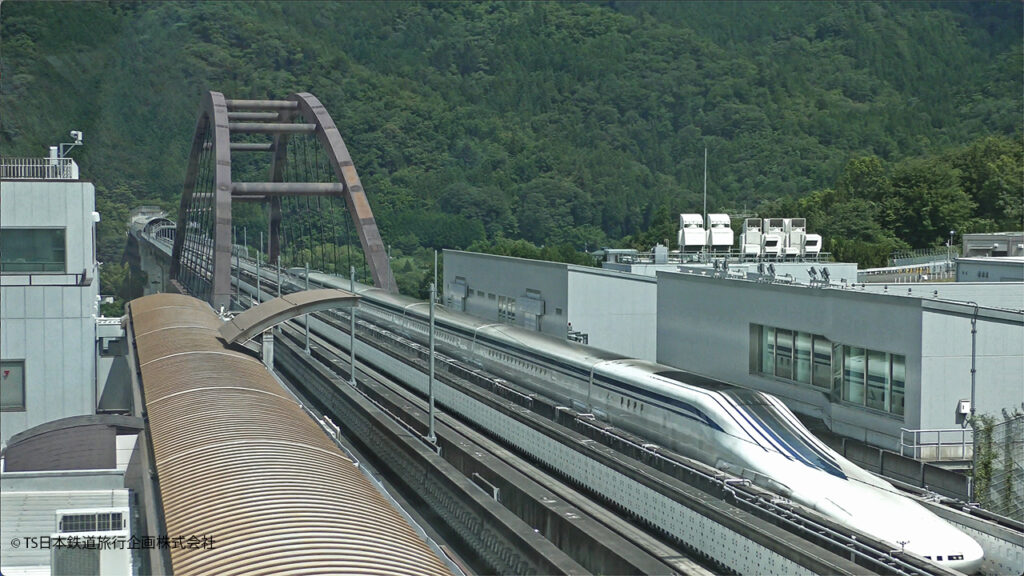
Maglev – Chuo Shinkansen construction delayed with opening date delayed until at least 2025.
JR Tokai has announced that the Maglev Chuo Shinkansen will not open until 2034 Fiscal Year (Apr 2034 ~ March 2035) at the earliest. Originally planned to be opened in 2027, the project has been beset with protests over the building of a tunnel beneath the Oi River in Shizuoka Prefecture. Other construction issues have also been experienced in what is a very difficult route, mostly in tunnels and going under the Japan Alps.
The cost has also gone up from an initial estimate of around ¥4 trillion to a new estimate of ¥11 trillion. This is due to ¥2.3 trillion in extra labour and material cost; ¥1.3 trillion due to inflation, ¥1.2 trillion due to “engineering challenges” and ¥400 billion due to tunnel design modifications.
Unlike most major railway infrastructure projects in Japan, the Chuo Shinkansen project is being funded and built by JR Tokai (partially with loans provided by the central government). JR Tokai has said that the costs increases will be absorbed by the company but has not said whether it will have to raise train fares, either for when the Maglev service starts or more generally.
JR Tokai Press release (Japanese) Click Here
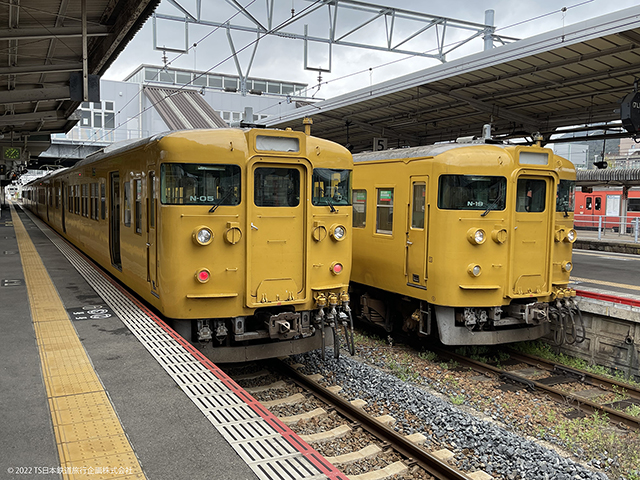
JR West Yellow 115 series EMUs to be replaced by new 227 series train called “Kizashi”
JR West has announced that a version of its 227 series electric unit will be introduced to the Yamaguchi area, primarily on the Sanyo Main Line. The 227 is used on urban / rural electrified lines in the Kansai (Wakayama & Hyogo Pref), Okayama area and Hiroshima area. It has replaced the much older JNR 115 & 113 series trains.
Chugoku region is currently the only area where you can regularly see JR operated JNR EMUs such as 115, 105 & 123 series trains, but their lives are now limited. The distinctive JNR Yellow regional livery will also disappear.
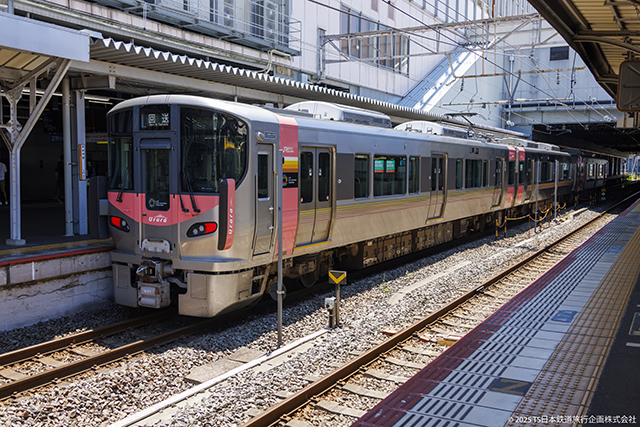
The 227 series trains to be introduced to Yamaguchi will be called “Kizashi”. Like the other regional 227 series trains, the “Kizashi” will have its own livery. They will also feature more safety and passenger comfort enhancements as well as being more energy efficient.
A total of 24 units will be introduced with 3 two car units and 6 3 car units. They will be based at Shimonoseki and will initially work services on the Sanyo Main Line between Shimonoseki ~Shin YamaguchiTokuyama~Iwakuni.
They will be introduced in the 2026 fiscal year (April 2026~March 2027).
JR West Press release (Japanese) Click Here
(Note picture is of the Okayama area 227-1000 “Urara” unit)
SL Moka to be out of service during fiscal 2026 due to major maintenance & examination.
SL Moka’s C12-66 steam locomotive will be out of action from April 2026 in order to undergo its legally required comprehensive general inspection.
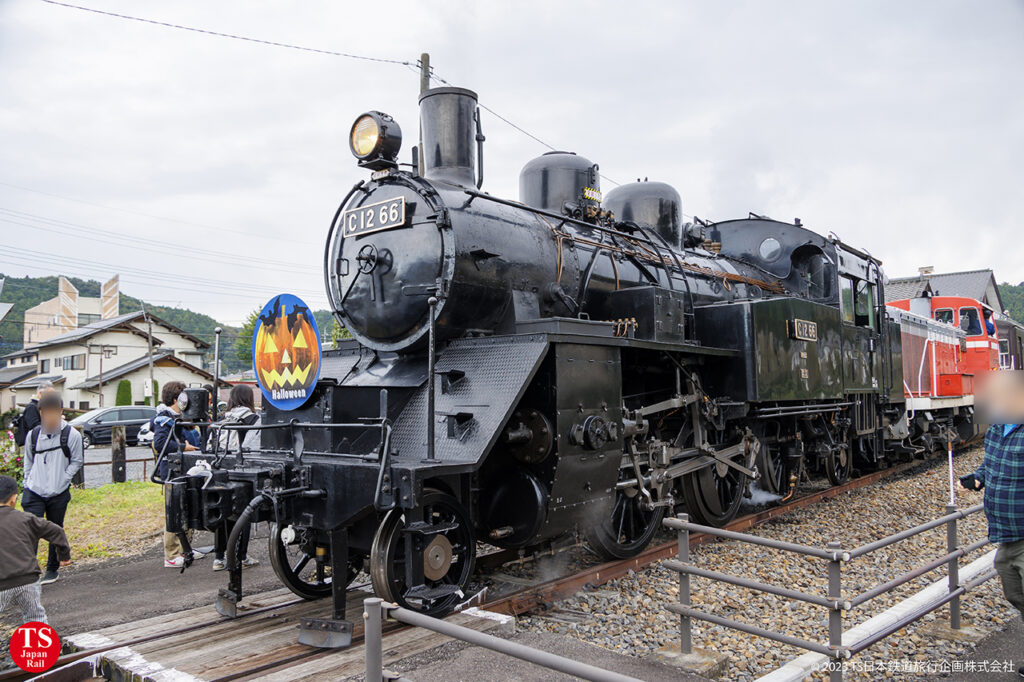
The general inspection involves removing all equipment from the vehicle for detailed examination, and of course any repairs to be carried out where necessary. The locomotive is expected to be back in service in April 2027. Moka Railways DE10 diesel locomotive (DE10-1535) and the series 50 coaches will also be undergoing inspections and repairs so will be unavailable to operate alternative services.
Moka Railway press release (Japanese) Click Here
Japan’s fleet of operational steam locomotives is rapidly aging. In the last few years alone, we’ve seen the SL Hitoyoshi (JR Kyushu), SL Kita Biwako (JR West), and SL Ginga (JR East) retired, while service suspensions have become increasingly common. At present, SL Gunma services and some Oigawa Railway steam services are suspended due to breakdowns and scheduled overhauls. In many cases, these suspensions last several months – sometimes a year or more.
The challenge is twofold: not only are the locomotives themselves getting older, but the number of skilled workers capable of maintaining and repairing them is also declining.
There are, however, some encouraging developments. Tobu Railway, a relative newcomer to modern-day steam operations, is using this situation as an opportunity to train new apprentices and attract more tourists to its lines. JR East and JR West also continue to maintain steam servicing facilities, as does Oigawa Railway. Even so, there is now only a single manufacturer of steam locomotive boilers left in Japan.
– including, we hope, more visitors from overseas – also have an important role to play. Steam services themselves are rarely major profit centers, and many of them run on rural lines that struggle financially. Quite simply, the more people who ride these trains, the better the chances that operators can justify keeping them in service.
At the same time, we kindly ask all railfans to remember that these trains operate on regular rail routes under strict safety regulations. Trespassing on railway property or adjoining land, and any form of interference with train operations, is strictly prohibited – just as it is on all railways.

See the TSJR Information Page: Steam Locomotives in Japan for information on steam trains operating in Japan
JR East’s E3 series Yamagata Shinkansen to end regular service by end of 2025
The Yamagata Shinkansen E3 series trains will finish regular service by the end of 2025. Currently only 4 trains each way are operated by E3 units (Tsubasa 121,129,139,159 from Tokyo, Tsubasa 136,148,158, 160 to Tokyo, but this may change)
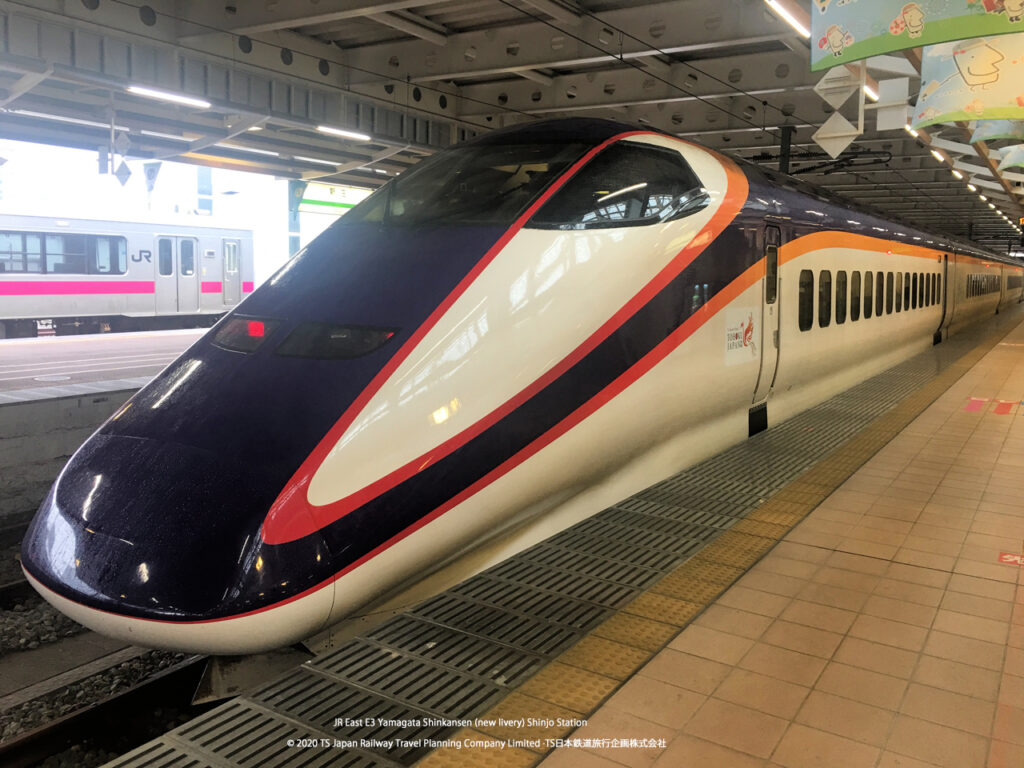
The newer E8 series will be used on all services. The E3 series was introduced in 1997 for the Akita Shinkansen and in 1999 the E3-1000 series was introduced to replace the 400 series which was the original Yamagata Shinkansen train. The E3-0 series used on the Akita Shinkansen was replaced with the current E6 Shinkansen in March 2014. Operating on the so called “mini Shinkansen” routes the E3 like the 400 series & E6 units are built to the smaller loading gauge with 2×2 seating throughout. Max speed is 275km.
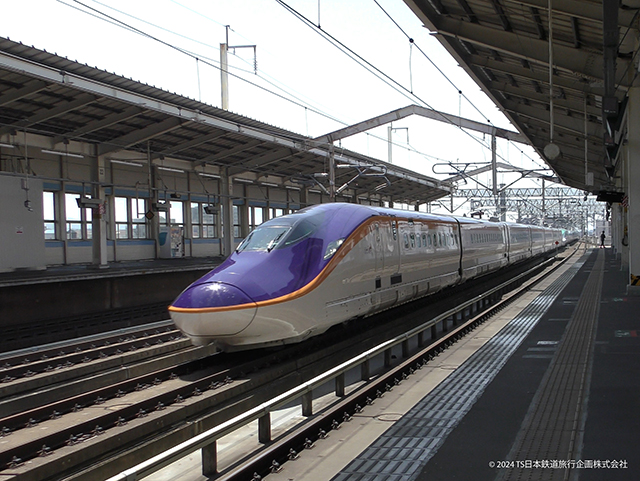
The E3 model will still survive though. One unit is being converted for “Shinkansen Freight”. The Shinkansen “East-i” inspection train is also based on the E3 model and will remain in operation until 2029~2030.
Tokyo Metro to introduce Fully Automated Trains on the Marunouchi Line
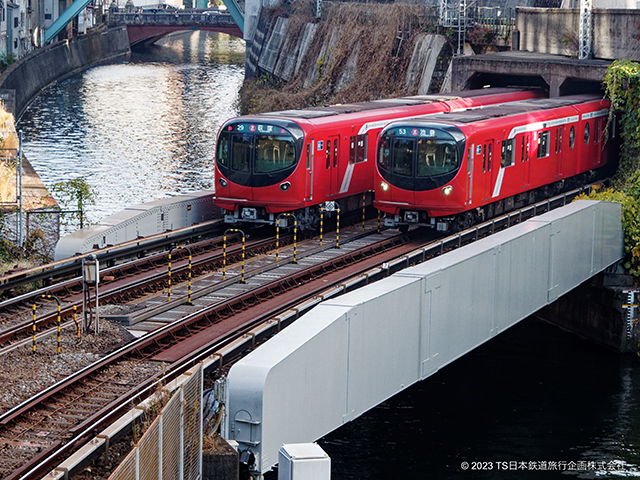
Tokyo Metro is planning to introduce full automation to its Marunouchi Line in fiscal 2027 (April 2027~March 2028).
Trains will operate under Japanese standard GOA2.5 which is the equivalent of the international IEC 62267 and requires an attendant to sit at the front of the train rather than a fully qualified driver. The Marunouchi Line currently uses Automatic Train Operation (ATO) which needs a driver to start the train, but the ATO then controls the speed of the train. (Versions of ATO are used on many urban lines.
Tokyo Metro is also rolling out CBTC (Communication Based Train Control) on all its lines (currently just used on the Marunouchi Line). CBTC allows moving blocks and is also easier to maintain as most equipment is either on the train or at central control centres. JR East is introducing such systems on some of its rural lines.
JR East’s latest E131 Electric Unit to debut on the Senseki Line (Tohoku) – first new train on this line in 80 years!
On 1st December (2025) the latest version of JR East’s E131 electric train will debut on the Senseki Line (Aoba-dori~Sendai~Ishinomaki).
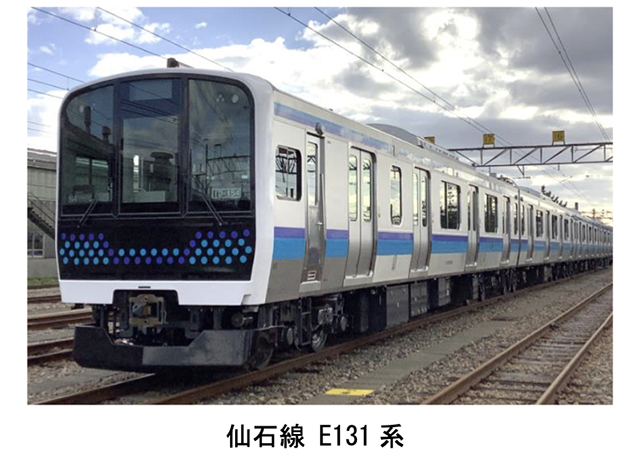
The Senseki Line is a bit of an outpost in Tohoku as it is the only JR line that is 1500V DC rather than 20KV AC in the region. This has meant that most of the rolling stock used on the line has been cascaded to it, including 103 series and current rolling stock 205 series exTokyo Yamanote Line stock. The E131-800 is the first new train type specifically built for the Senseki Line in 80 years(*).
The E131 EMUs are based on the E231 / 233 design but for less busy outer suburban / rural routes. Earlier versions of the E131 are running on rural Chiba routes, Sagami Line, Tsurumi Line, northern end of the Utsunomiya Line (Tohoku Main Line) and Nikko Line. They have been designed for one man operation.
JR East planning to introduce new shinkansen inspection train…
JR East has announced that it is planning to introduce a new Shinkansen Inspection train to replace the current E3 series East-i train. Unlike JR Tokai and JR West have or are withdrawing their shinkansen inspection trains (Doctor Yellow) in favour of using normal shinkansen trains fitted with monitoring equipment carry out inspections, JR East has decided to have a new specialist inspection train. This is because of the different shinkansen lines that JR East Operates, particularly the “mini shinkansen” Yamagata and Akita Shinkansen lines.
The new inspection train will be introduced in fiscal year 2030 (April 2023~March 2031)
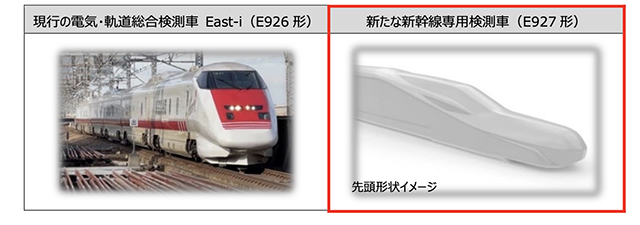
The new train will have a maximum speed of 320km/h (where allowed) and will operate on the Tohoku, Joetsu, Hokuriku, Yamagata and Akita Shinkansen lines and will also carry out inspections on the JR West section of the Hokuriku Shinkansen and the Hokkaido Shinkansen (JR Hokkaido).
JR East press release (Japanese): Click here
Short News Items
JR West to retire the Hello Kitty Shinkansen by March 2026
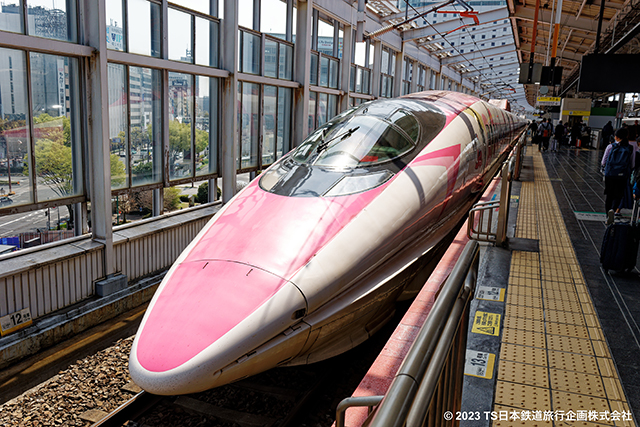
JR West has reported that the Hello Kitty Shinkansen will be retired by Spring 2026. This is part of the retirement of the 500 series shinkansen which is expected to be completed in 2027. (JR West pays a license fee to Sanrio the owners of Hello Kitty). They have also announced that the Hello Kitty wrapping used on the Limited Express Haruka (to / from Kansai International Airport) will end in 2027.
Freight Train stopped on Tokaido Mainline due to a hot axle. Bogie had to be replaced in siyu leading to major disruption
A freight train on the Tokaido Main Line between Washizu and Shinjohara in Aichi Prefecture was bought to a standstill after abnormal heat was detected by track sensors at 2am on the 2nd November. As the train could not be moved, JR Freight had to transport a new bogie to replace one on one of the container (コキ) wagons to where the train was stopped. This led to the Tokaido Main Line being closed all day between Toyahashi and Shinjohara.
Seibu taken delivery of Tokyu 9000 series (ex Oimachi Line)
Seibu has taken delivery of at least one Tokyu 9000 series and is now converting, including new livery, for use on its lines. These trains will be known at Seibu 7000 series. Seibu is also acquiring Odakyu 8000 series units which are also being given a new livery ab converted. This is part of Seibu’s efforts to replace older trains used on some of its branch lines with trains with the more power efficient VVVF (Variable Voltage Variable Frequency) equipment that converts DC power to AC power and gives smoother acceleration / de-acceleration as well as better power consumption.
The Japanese government is pushing for all electric trains to be converted to be more power efficient, to the extent taht it is providing subsidies to smaller railway companies for new trains.
Times for last trains on the Joetsu & Tohoku Shinkansen routes to be bought forward to facilitate essential maintenance work
JR East has announced that the departure of last trains on the Joetsu Shinkansen (Tokyo~Omiya~Niigata) and Tohoku Shinkansen (Tokyo~Shin Aomori) will be run earlier from the March 2026 timetable.
Labour shortages and the need to carry out essential renewal work on both lines mean that JR East has been having difficulty securing workers to carry out the work at night in the relatively short time between the last and first trains.
To manage this by running the last train earlier gives more time for the fewer workers to carry out the work. JR East has nor published the timetable yet, but last trains will depart around 20 minutes earlier than now.
Ideas and itinerary Planning for Rail Enthusiasts and Rail Enthusiast Groups
TS Japan Rail specialises in helping those who want to Explore Japan by Train or Explore Japan’s Railways For rail enthusiasts we can help with interesting railway ideas and travel planning. For group tours we work with a local travel agent to provide a complete package with all the bookings made.Being local we have lots of ideas and information, including interesting routes and trains that only locals know about!