

Introduction
Welcome to the February 2026 Japan Rail Enthusiast Magazine.
March 14th sees revisions to JR and some non JR rail company schedules. We have summarised those changes that have been published in advance. In fact there is nothing really major, but if you are planning a trip to Japan it is worth rechecking the timing of your trains.
Heavy snow and in some cases record breaking snow during the second half of January and early February caused disruption to many lines in the Tohoku, Koshinetsu and Hokuriku areas. Since mid February it has warmed up a little and most rail lines are back to normal, although some lines are under “warning” of possible disruption. Weather is a large cause of rail travel disruption, although to be fair roads do not escape either.
I travelled on JR East’s Yamanote Line “All Around Tokyo on the Yamanote Line” [東京まるっと山手線] excursion train recently. It was a special train that basically ran non-stop around the Yamanote Line with commentary on interesting places for both rail enthusiasts and in general. Although non stop, it took slightly longer than a normal trip round the Yamanote Line as it was slotted in between normal services. The JR East staff who helped organise the trip and gave the commentary through out the journey were very enthusiastic and made the journey very interesting. We will be publishing an article soon on points of interest around the Yamanote Line.
(E235 unit 39 waiting to start the tour at Ikebukuro)

We often find that rail fans visiting Japan are not so interested in “modern trains” (except the shinkansen) but once in Japan they are often fascinated watching how efficiently the trains in the urban areas work, often with 2 or 3 minute headways.
Stephen Turner
JR East’s troubles continue…
We seem to be regularly reporting trouble on JR East’s network that has lasted many hours and inconvenienced 10,000s if not 100,000s of its customers and others.
Two further power related incidents occurred in January and February resulting in services being suspended for many hours:
- On the 30th January an overhead power cable failure at a Joban Line Platform resulted in Joban Line trains between Shinagawa and Abiko (Local) / Matsudo (Rapid) being suspended for 7 hours effecting 230,000 people
- On the 8th February another overhead power cable failure resulted in train being partially suspended on the Utsunomiya Line (Tohoku Main Line) for 3 hours into the next day, with 190,000 people affected.
Both these incidents, particularly the Utsunomiya line one have been put down to lack of maintenance. The president of JR East has partially blamed this on a backlog of maintenance caused by the Covid Pandemic and has vowed that the maintenance budget will be increased. In the Utsunomiya incident the overhead cable was found to only 4.1mm thick, but JR East’s procedures are that cables under 7.7mm must be replaced.
A further but different incident occurred on the 2nd February when an elevator at Hatchiobori Station on the Keiyo Line caught fire due to sparks generated when exposed wiring came into contact with metal parts after the protective coating on a pump used to drain water from inside the escalator peeled off ignited combustible material. This incident led to the Keiyo Line being suspended for 3 hours during the evening rush hour.
The Ministry of Land, Infrastructure, Transport and Tourism (MLIT) has ordered JR East to both improve procedures to avoid these type of incidents and to introduce procedures that allow passengers trapped on trains between stations to be rescued more quickly.
JR East has applied for approval from the Government to partially close the Kururi Line from 1st April 2027
Following agreement from local governments to close the Kururi Line in Chiba Prefecture between Kururi and Kazusa Kameyama, JR East has now applied for approval from the Ministry of Land, Infrastructure, Transport & Tourism (MLIT) to close the line from 1st April 2027.
As part of the agreement with local governments, JR East will underwrite the cost of a replacement bus service for 18 years. The 9.6km section of the Kururi Line only averaged 55-64 passengers a day and recovered only 0.6% of operating costs from fares.

When the line was originally planned it was envisaged that it would cross the Boso Peninsula joining Kisarazu with Ohara, connecting with what is now the Isumi Railway.
The section between Kisarazu and Kururi will continue to operate. The line is 1 of 2 non electrified lines operated by JR East in the Kanto region and uses JR East KiHa E130 in either 1 or 2 car formations.
JR East reintroduces its JR East Pass for inbound visitors
From the 14th March the “JR East Pass” for inbound visitors will be available again. The pass allows unlimited travel on all of JR East’s Lines and trains. It is also valid on some non Jr Lines such as the Aoimori Railway, Iwate Galaxy Railway, Sanriku Railway to name some.It comes in a 5 day and 10 day version costing ¥35,000 & ¥50,000 respectively.
With JR East raising fares in March, the price of all its rail passes for inbound visitors will be increased.
You can find full details here as well the other rail passes (for visitors) that are available in the TSJR JR Japan Rail Pass Guide:
All you need to know about JR Japan Rail Passes and regional passes:
New Train News
Enoden 700 series (Enoshima Electric Railway)
The first new train for Enoden in 20 years was delivered in January, the 700 series. It is a two car unit (both cars Motor driving) that can accommodate 141in total (101 standing).
The train provides an upgrade in passenger comfort and safety. On the sea facing side seats look out towards to the sea. Windows also are anti-glare.
It is also the first Enoden train to have regenrative braking which with VVVF will reduce energy use by 49% compared to the older 1000 series.
Trains are expected to enter service after April 2026.

The train will replace 1000 series units. Initially two 700 series units have been ordered. No decision has been made on further orders yet. The train is manufactured by JR East owned J-TREC at their Yokohama plant.
Keio 2000 series
31st January saw the new Keio 2000 series start service. This new train 10 car train is built by J-TREC. Keio operates trains in the west of Tokyo between Shinjuku, Hachio and Takao. It uses the 1,372mm gauge (except Inokashira Line). Some trains run through to the TOEI Shinjuku Line.

The trains feature a rounded front and rear. Internally the trains represent an upgrade in passenger comfort with 460mm seats, enlarged windows and air purifers. For safety each car has 4 CCTV.
Under the floor, Full SiC VVVF inverters will provide 20% better energy efficiency than the 7000 series that these trains will replace.
Car 5 has free space for families, this line being a popular way to get to Mt Takao from Tokyo.
The 2000 series will replace the aging 7000 series with the full roll out of 4 units expected to be completed in March 2027.
Other train news
- Tenryu Hamanako Railway in Shizuoka Prefecture has taken delivery of its first THG100 series Diesel Electric car. It is based on Kawasaki’s GreenDEC designed for smaller regional railways like “Tenhama sen” as it is known amongst locals. Most diesel rail cars in Japan are still Diesel engined with mechanical transmission, but Diesel Electric cars are making in roads with JR East, JR Hokkaido & JR West switching to DEMUs on their rural lines where hybrid Diesels do not make sense. The THG100 will gradually replace the TH2000 & TH2100 as Tenhama plans to order 1 new car a year.
- Sotetsu (Sagami Railway) 13000 series. Expected to enter service in the spring of 2026, this train, manufactured by J-TREC will gradually replace the older 8000 & 9000 series trains. The units will be 8 car, as Sotetsu standardises on 8 car rather than 10 car for services wholly within the Sotetsu network. The trains will be used on Sotetsu Line services and not through JR / Tokyu services. The trains are installed with advanced VVVF electrical controls and together with the 8 rather than 10 cars will be 39% more efficient that the 8000 & 9000 series units they are replacing.
- Meitetsu 500 series Replacing the older 100 series that date back to 1978, the 500 series is the first new train Meitetsu Train for Meitetsu ~ Nagoya Subway through services (Toyota Line / Inuyama Line~Nagoya Subway Tsurumai Line) in 38 years. Deployment will start from spring 2026. These tarins will be 38% more energy efficient than the 100 series with SiC VVVF installed power control equipment installed. The trains are manufactured by JR Tokai’s train manufacturing subsidiary Nippon Sharyo.
- JR East Senseki Line E131-800系 / no more 205 series in regular operation on JR East

JR East has now replaced all 205 series trains operating on the Senseki Line in Miyagi Prefecture with the new E131-800 series trains. The Senseki Line is unique in Tohoku as it is the only JR line operating at 1500V DC power (everything else is 20KV AC or non electrified). The Senseki Line is a commuter / tourist line and as well as ex Yamanote Line 205 series has seen JNR 72, 101 & 103 series trains which were more familiar in the Tokyo and Kansai urban areas in times past. The 205 series, which replaced the 103 series was first introduced to the Senseki line in 2002.
- JR Hokkaido Rumoi Main Line to close 1st April what is the shortest “Main Line” in Japan at 14.4km, will close on 1st April 2026. In fact this is the last part of the line to close as 2 sections of what was once a 66.8km line had been closed previously. Ironically JR Hokkaido will be operating some extra trains on this line during March as it expects a big increase in passengers prior to its closure. Last train is scheduled to run on the evening of the 31st March (20:58 Ishikari Numata to Fukagawa).
- JR Riku West Line reopens after 3 years. The line had been closed due to a new road tunnel being built, but after 3 years and 8 months (originally the closure was meant to be for 2 years) the line reopened on the 16th January.
Two stations on the route however have not reopened due to low usage (Uzen-Zennami and Takaya). This is a scenic line running much of the way along the Mogami river. The reason the railway had to be temporary closed was due to a new tunnel being constructed on National Road 47, which was just 3m from the railway tunnel. Unfortunately due to heavy snow, services on the line had to be suspended on many days late January and into February.
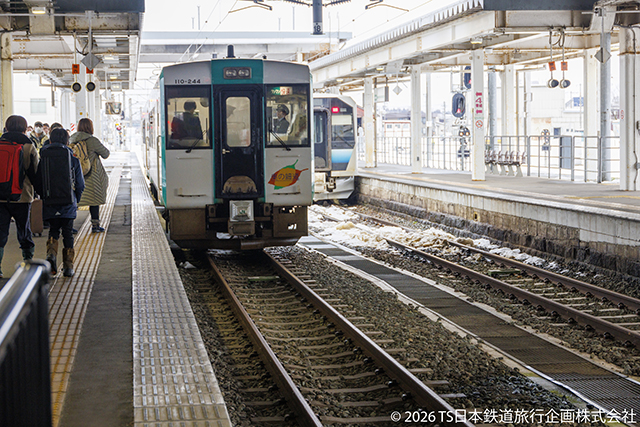
Changes in the 14th March JR timetable revisions
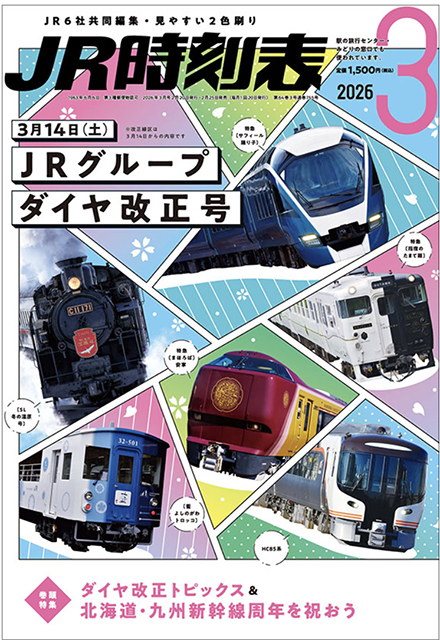
Rail fans in Japan await eagerly the March and October JR timetables published by Kotsu Shimbunsha (the official JR timetable) and JTB (the rival).
Although the timetables are published monthly, the major changes take place Mid March and Mid October.
We have listed the major changes below, using the notices published by each of the JR companies.
March 2026 does not see any major changes, although the JR Tokaido Line will see an increase in hourly departures on some days (particularly around holidays).
Other changes are around reducing overcrowding on some services, including those popular with tourists.
Apart from the already planned closure of the Rumoi Main Line in Hokkaido, there are no major reductions in services.
[please note there could be other minor changes that have not been publicised, so please check the timetable before travelling!]
We have listed changes to shinkansen and inter company area trains first and then changes to Limited Express / Rapid / Local / tourist trains next. In these sections you will see links to the relevant JR company notices on timetable changes.
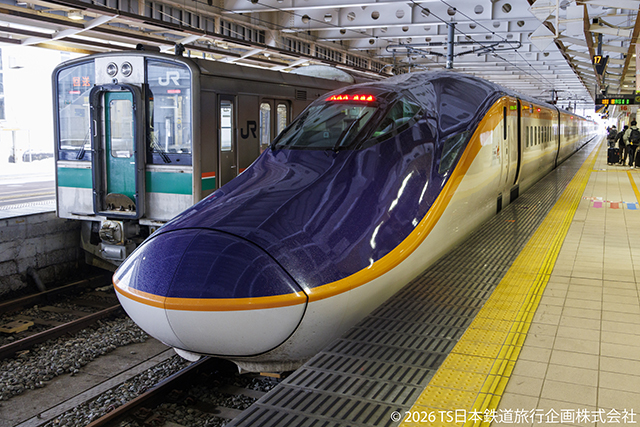
JR Tokai & JR West – Tokaido Shinkansen~Sanyo Shinkansen
- Increase in frequency of Tokaido Shinkansen (Tokyo~Shin Osaka) services during the morning and evening “rush hours” on specific days. The maximum number of trains that will increase from 12 to 13 trains an hour towards Shin Osaka departing from Tokyo between 7am~10am and Departing Shin Osaka between 2pm~5pm. The extra trains will operate on particularly busy days like Year end / New Year, Golden Week and Obon holidays and other days that it is deemed that extra services are required.
- A new early morning Nozomi service (Kyoto->Tokyo) This service, Nozomi 548, will depart Kyoto at 6:03 and arrive at Tokyo at Tokyo 8:12. The service will primarily operate on Mondays or days after a public holiday and Saturdays (or first day of consecutive holiday). (This is not a daily service)
- Change to early morning Nozomi service from Nagoya. Nozomi 288 will depart Nagoya at 6:28 arriving at Tokyo at 8:03. This service previously operated as an occasional service but will become a daily service. Nozomi 268, will become a temporary service (Nagoya 6:37) and be renamed Nozomi 546, operating on busy days. It will not operate on days when Nozomi 548 is operating (see above).
- A new last Nozomi train from Hakata to Shinagawa (Nozomi 206) will be introduced departing Hakata at 19:18 and arriving at Shinagawa at 23:59. This train will run on designated days only (check timetable). It will provide people visiting the Sanyo region from the Tokyo area with 19~21 minutes extra compared to the daily last train to Tokyo (Nozomi 64).
- A new last train from Tokyo to Hiroshima (Nozomi 215) will be introduced departing Tokyo at 20:09 and arriving at Hiroshima at 23:59. This train will run on designated days only (check timetable). It will provide people visiting from Tokyo from the Hiroshima area 9~11 minutes area time in Tokyo compared to the daily last train (Nozomi 89)
- Kodama services between Nagoya / Gifu Hajima and Tokyo changes. A number of changes will be made to Kodama services between Nagoya and Tokyo:
- Kodama 700 (Nagoya->Tokyo) will be renamed Kodama 800 and will be extended to operate from Gifu Hajima. The departure time from Nagoya will change from 6:45 to 6:42 (other times do not change). Passengers will also be able to change to Nozomi 210 at Nagoya allowing arrival at Tokyo at 8:23
- Kodama 764 will become Kodama 864 with later departure times. Kodama 864 (Nagoya->Shizuoka) will depart Nagoya at 22:21 (instead of 22:14); Times up to Kakegawa will be slightly bought forward.
JR East Tohoku Shinkansen, Yamagata & Joetsu Shinkansen
- Two new Hyabusa services (one in each direction) between Tokyo and Shin Aomori will be introduced.
- Two Yamagata Shinkansen (one in each direction) will be speeded up by 4 mins as a result of the introduction of the E8 series shinkansen.
- Changes to two evening Yamabiko services: Yamabiko 153 will make an additional stop at Shiroishi Zao and will arrive at Sendai at 20:04 instead of 19:59; Yamabiko 215 will no longer run, but a new Nasuno 265 will operate at the same time from Tokyo to Koriyama arriving at 19:14 (Yamabiko arrived at 19:28).
- Last trains on the Tohoku Shinkansen will run earlier to allow extra time for night time maintenance: Tohoku Shinkansen last train to Morioka, departs Tokyo 20:20->20:08; Last train to Sendai departs Tokyo 21:44->21:24, also some changes to the late Nasuno services)
- Last trains on the Joetsu Shinkansen will run earlier to allow extra time for night time maintenance: last Tanigawa service to Echigo Yuzawa departs Tokyo 22:28->22:12.
JR East & JR West Hokuriku Shinkansen
- Journey times for some Kagayaki services between Tokyo~Kanazawa~Fukui~Tsuagru will be speeded up by 1~3 minutes. The fastest time between Tokyo and Fukui will be 2hr 49mins.
- Kagayaki 517 will change its departure time from Tokyo to 20:00 (formerly 19:56).
- An extra non regular Kagayaki service will operate on specific days (check timetable) departing Tokyo at 15:48 and arriving at Kanazawa at 18:25.
JR Kyushu – Kyushu Shinkansen
- Tsubame Shinkansen timetable revisions some minor changes to improve connections with Sanyo Shinkansen at Hakata.
- Sakura Shinkansen – new non regular trains between Kumamoto and Hakata. Extra non regular trains will be introduced early morning / late evening between Kumamoto~Hakata.
JR East / JR Tokai / JR West – Sunrise Express

West bound train to depart Tokyo earlier. To allow more time for overnight maintenance work, westbound services of the combined Sunrise Express Seto and Sunrise Express Izumo will leave Tokyo (and scheduled stops to Hamamatsu) 24 minutes earlier. than at current. This means that the train will depart at 21:52 from Tokyo rather than 22:14. East bound trains will be unchanged
JR East (conventional services)

- There will be a small number of minor changes / extra trains operating on the following lines:
- Tokaido Main Line: an extra Limited Express Shonan will depart Tokyo at 21:35 which means that there will be a approximately 1 train every 30 minutes between 17:30~22:00.
- Shinonoi Line / Chuo Main Line Limited Express Azusa 8 (Matsumoro->Tokyo) and Limited Express Azusa 17 (Shinjuku->Matsumoto) will become 12 car trains (currently 9 cars).
- Saikyo Line one extra Commuter Express train from Kawagoe->Shinjuku.
- Yokohama Line / Negishi Line three early morning trains will be extended to operate from (2) and to (1) Sakuragicho on the Negishi Line
- Senseki Line services will be increased between Aobadori and Tagajo between 10:00~14:00 from 3~5 trains an hour to 4~6 trains an hour. All trains will be operated by new E131 series trains and be one man operated.
- Nambu Line the timetable will be partially adjusted to improve time keeping.
More information (Japanese) click here
JR Tokai Conventional Services

- Kansai Main Line / Kisei Line changes to some evening services
- Taketoyo Line and Kansai Main Line trains to be operated with 4 car 315 series. All trains on these two lines (except Limited Express Nankai and Rapid Mie) will be operated by the newer 315 series trains, and all will be 4 car. Previously 2 car 313 series were used for some services so this will lead to an increase in the number of seats.
For more information click here (Japanese)
JR West Conventional Services

- JR West is extending its “Ureseat” うれしート service, which is a Premium Seat service on some Rapid (快速) Special Rapid (新快速) & Local express / Section Rapid (区間快速) services. This includes increasing the number of trains with the special うれしート carriages and also introducing on to several new lines such as the Kure Line and Sanyo Main Line in the Hiroshima area. [the “Ureseat” service is similar to JR EAst’s Green Car service on commuter lines and the premium seat services provided by some non JR companies (e.g. Keihan, Hankyu, Tobu, Tokyu). On the JR West service seats must be booked in advance and there is a premium charge).
- Nara Line: Additional Stops for “Miyakoji Rapid” and “Section Rapid” Trains The “Miyakoji Rapid” and “Section Rapid” trains will make additional stops at Inari Station and the “Miyakoji Rapid” will also stop at JR Kokura Station and Shinden Station.
- Hokuriku Main Line: Discontinuation of Temporary Rapid Service The non stop rapid service operating one train each during the early morning (Tsuruga 6:31 ->Maibara 7:08 and late night (Maibara 22:48->Tsuruga 23:20 will be discontinued.
- New Station opening 14-Mar-2026:
- Sanyo Main Line: Tegarayama Heiwa Kōen Station (手柄山平和公園駅) between Himeji Station and Egaho Station. In addition to the New Rapid, Rapid, and Local trains, the commuter limited express ‘Raku Raku Harima’ will also stop there.
For more information Click here (Japanese)
JR Hokkaido

The major change for JR Hokkaido is that all Limited Express trains will be Reserved Seat Only. You can book seats on line, using the JR East Ekinet platform.
- Line closure: Rumoi Main line will close on 1st April 2026. Prior to the closure a special timetable will be operated with extra trains to meet expected high demand.
- Minor changes on Hakodate Main line between Sapporo and Otaru. The 10:06 and 11:06 trains from Sapporo to Hoshimi will be extended to Otaru.
- Changes to Limited Express Suzuran between Sapporo and Higashi Muroran / Muroran In order to better meet customer demand, including passengers travelling to Noboribetsu, Suzuran 4 will depart Sapporo at 9:21 instead of 11:25. Suzuran 12 will depart Sapporo at 21:12 instead of 22:00. In the return direction Suzuran 7 will depart Muroran at 11:29 instead of 13:29.
- Furano Line & Sekisho Line – minor changes, including withdrawal of some little used night time trains.
For more information click here (Japanese)
JR Kyushu Conventional Services

West Kyushu area
- Revision to limited express train operation system on the Nagasaki Main Line and Sasebo Line to alleviate congestion.
- More limited express “Relay Kamome” and “Midori” trains between Hakata and Takeo Onsen, and change the rolling stock on some trains to increase seating capacity.
- More local trains between Kohoku and Hizen-Kashima/Hizen-Hama on the Nagasaki Main Line.Some limited express trains will newly stop at Kohoku Station.
- The schedule for the Non regular “Kamome” service will be revised during the morning hours when it is most frequently used.
Miyazaki area
- In the Miyazaki area a revised timetable for daytime limited express trains “Nichirin” and “Hyūga” as well as local trains will be introduced to improve convenience for passengers and also to improve access to Miyazaki Airport.
- The Tourist Train limited express “Umiyuki Yamasaki” will be rerouted via Miyazaki Airport on the Miyazaki->Nango service to improve access from Miyazaki Airport to the Nichinan area. Additionally, some stopping stations will be revised.
- Nichinan Line – number of local trains between Minami Miyazaki and Aoshima will be increased.
Fukuoka and Kita Kyushu area
- Select limited express trains “Sonic” (Hakata~Oita~Saiki) and ‘Kirameki’ (Yukahashi~Mojiko~Kokura~Hakata) will make additional stops at Akama, Togo, and Yoshizuka.
- The number of cars for the morning commuter limited express “Kasasagi 101” (Mojiko~Hakata~Saga~Hizenkashima) will be increased to alleviate crowding.
- The schedule for the limited express “Kaiou” on Saturdays, Sundays, and holidays will be revised to improve access to Fukuoka from Nogata.
Oita Area
- The Kyushu Odan Limited Express No. 5 will extend its route to Beppu.
- On the Nippo Main Line – the number of cars on some trains during the morning and school commute will be increased to alleviate overcrowding.
Kagoshima Area
- Some limited express “Kirishima” trains (Miyazaki~Kagoshima) to improve connections with the Kyushu Shinkansen at Kagoshima Chuo Station
- Nippo Line / Kagoshima Main Line – the number of cars on some trains during the morning and school commute will be increased to alleviate overcrowding.
- Nippo Line / Kagoshima Main Line – some local trains will have their journeys extended.
Saga Area
- Chikuho Line – number of trains operating non stop between Karatsu and Meinohama will be increased,
Kumamoto Area
- Kagoshima Main Line – Some local trains will see an increase in the number of cars to alleviate overcrowding.
- Hohi Main Line – some retiming of trains in the evening comuting time and during school time to provide better connections with the Kyushi Shinkansen.
Nagasaki Area
- Sasebo Line – minor retiming of trains at Haiki to improve connections with Omura Line and Nagasaki Line for passengers travelling to the Arita and Kohoku areas.
General: JR Kyushu is reviewing passenger usage on all lines so further changes may be made.
For more information click here (Japanese)
JR Shikoku
JR Shikoku will not make any major revisions to its timetable on 24th March 2026.
Non JR Company timetable changes
Non JR rail companies, particularly the larger ones, will usually implement their revions on the same day that the JR companies do so. Most of these will be minor. We highlight the following:
Tokyu
- Tokyu will revise last train times on the Toyoko Line, Meguro Line, and Oimachi Line.
- On the Denetoshi Line the following changes will be made in order to alleviate overcrowding on the Denentoshi Line platform at Shibuya station and also providing more trains on the heavily congested section of the Denetoshi Line between Futako Tamaga & Shibuya on weekend & holiday mornings:
- Weekdays between 6pm~7pm all express trains will become semi express trains
- On Saturday, Sunday and holidays between 9am~1pm, on upbound services from Chuo Rinkan to Shibuya most express trains will become semi express trains.
These changes will mean that the timing of all trains will need to be altered. (note Oimachi Line express trains travelling from / to Chuo Rinkan & Nagatsuta will remain as express trains).
- Ikegami Line and Tokyu Tamagawa Line will see an increase in trains between 17:00~18:00 on Saturday, Sunday and holidays.
- Some trains on both the Ikagami Line and Tamagawa Line will be retimed to reduce delays.
You can get more information by clicking here (Japanese)
Nankai (timetable revision March 28th)
- On the Koya Line, the new tourist Train “Gran Tenku” will start operation (2 return journeys daily between Namba~Gokurakubashi)
- An extra Limited Express Rinkan will operate on weekday mornings, however Limited Express Rinkan 2 will change from 8 to 4 car formation, and the new service Rinkan 4 will be 4 car.
- Nankai is revising services departing Namba between 7pm~8pm and reducing most trains to 4 car in order to rationalise rolling stock movements and save power.
You can get more information by Clicking Here (Japanese)
Other companies may also have minor timetable changes.



Comments