Welcome
With summer now in full swing news is a bit light this month but we still have some interesting pieces in this month’s Japan Rail Enthusiast Magazine.
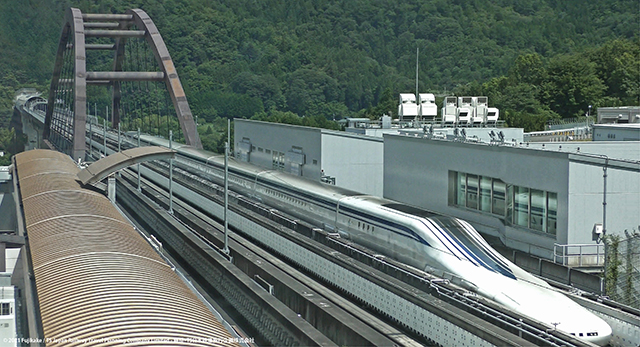
The biggest obstacle to the construction of the Maglev Chuo Shinkansen has now officially been resolved with Shizuoka Prefecture and JR Tokai agreeing measures will be taken to protect The Ōi River. The opening of the first section between Tokyo and Nagoya is still a few years off though.
An embarrassing derailment of one of Kintetsu’s new 8A electric multiple units caused chaos on the Kintetsu Kyoto Line at the end of June.
There was also a surprise decision by the government’s ruling parties on the routing of the Hokuriku Shinkansen Tsugaru~Shin Osaka section, much to everyone’s surprise the line will not go via the current Kyoto Station, but at a station 5km away.
More on these stories and others below.

Have a Japan Railway Question you want to ask us? If we do not know the answer, we will know someone who can! Want to know more about how TS Japan Rail can help you?

Contact Us https://railfan.tsjapanrail.net/contact-enquiry-form/ or (mail) info@tsjapanrail.com
Shizuoka Prefecture and JR Tokai come to agreement on the Chuo Shinkansen Maglev construction through the prefecture
On 18th July the Governor of Shizuoka Prefecture and JR Tokai signed an agreement allowing the construction of the Chuo Shinkansen Maglev route to start.
There had been an impasse between the two, and in particular the former governor of Shizuoka prefecture on the construction of the relatively short stretch of the line through the prefecture and the impact on the water levels on the Oi river. The agreement means that JR Tokai will study and take appropriate actions to avoid disturbing the river flow, which feeds a major tea growing area of the prefecture as well as being a major general water resource.
Any update on when the line may open?
JR Tokai has not announced an updated completion date for the Tokyo~Nagoya section which is currently slated for “some time in the 2030s”. As most of the line will be in tunnels, including under the Japan Alps, there are still some other challenges to be overcome.

Hokuriku Shinkansen extension to Osaka route “decided”
On the 15th July, the ruling parties of the Japanese Government (Liberal Democratic Party and the Japan Innovation Party) announced the proposed route for the Hokuriku Shinkansen extension between Tsuruga and Osaka.
Much to many people’s surprise the governing parties are going to adopt the so called Katsuragawa Route, which is similar to the Obama~Kyoto option that had been announced before, but with a big difference. The original plan had the line’s Kyoto Station situated very close to Kyoto Station but underground. the adopted proposal has the “Kyoto Station” situated at Katsuragawa, which is a little way out of the centre of Kyoto on the JR Tokaido Main Line. It would require passengers heading for Kyoto Station and the popular tourist areas to travel at least 5.3km to Kyoto Station using regular trains (takes about 5 minutes). There is no connection to other lines at Katsuragawa. (below map shows Map shows rough route not exact alignment)


When is the extension likely to open?
There is still a long way to go before this plan is finalised and approved by parliament, but this is an important step. Construction unlikely to start until sometime in the 2030s and as much of the route will be in tunnels, it is not likely to open until 2040s
JR East breaks with the old JNR organisational structure and localises decision making…
On 1st July JR East introduced a major reorganisation designed to make decision making, both operational and general business, more local. The 12 regional branches (covering Metropolitan Tokyo, Omiya, Hachioji, Yokohama, Chiba, Mito, Takasaki, Nagano, Niigata, Tohoku Region (Sendai), Morioka, Akita) have been replaced with 36 Area Operation Centers. This is a big change to a structure that runs back as far as the Japan National Railways (JNR) era.
The Area Operation Centers (AOCs) will be responsible for management of stations, rolling stock depots and train crew depots as well as train operations and track and other infrastructure maintenance. The idea is that as well as planning and providing services to meet local requirements, when things go wrong to be able to respond more quickly.
The new Area Operating Services will also be responsible for marketing for example running tourism campaigns for their areas. This may mean that we see more local area tourist campaigns in addition to the regional Destination Campaigns.
The Area Operation Centers will also be responsible for liaising with their local governments and communities so that the railway can be more responsive to the needs of their communities. The AOCs will also be responsible for managing the railway real estate in their areas, in many cases working with local governments to make better use of spare land. The big idea behind this reorganisation is to give AOCs autonomy to manage their rail services and other assets, something that in the past was not so easy when you had to report to a distant branch head office (e.g. Fukushima Pref, including the Aizu Wakamatsu and Iwaki areas used to be part of the Sendai / Tohoku area; Shonai in Yamagata Pref was part of the Niigata area)
Head office will be responsible for Policy & Strategy, Shinkansen, Technology & innovation, and research & development.
(the 36 Area Operation Centers are: Aomori, Morioka, Sendai, Akita, Yamagata, Shonai, Fukushima, Hamadori, Mito, Tsuchiura, Tochigi, Gunma, Omiya, Urawa, Kumagaya, Musashino, Chiba, Boso, Keiyo-Sobu, Matsudo, Tokyo, Shinagawa, Shibuya, Ueno, Shinjuku, Ikebukuro, Hachioji, Tachikawa, Yokohama, Kawasaki, Shonan-Izu, Niigata, Nagaoka, Yamanashi, Nagano, Matsumoto)
JR East announces new Shinkansen Inspection Train
JR East is deviating from the JR Tokai / JR West Model of doing track and equipment inspection equipment on passenger trains running on the Tokaido and Sanyo Shinkansen lines (following retirement of the Dr Yellow Trains) and has announced a new inspection train which will cover the Tohoku, Joetsu, Hokuriku, Yamagata & Akita shinkansen lines.
The reason for the different strategy is that JR Easts operates two smaller loading gauge shinkansen lines (the so called mini shinkansen Akita and Yamagata Shinkansen Lines) , different train types and over a variety of weather conditions so it was determined that having a specialist train was more practical.
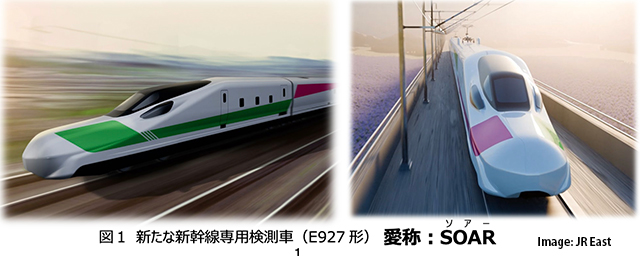
The new train will be called “SOAR” and will be based on the E6 Akita Shinkansen model and be capable of 320km/h. The train will be designated as E927.

It will replace the current E926 East-i Shinkansen model, which is based on the E3 shinkansen type which has now been withdrawn from service.
The new inspection train will have several new features and upgrades from the current inspection train. A new feature includes PQ Estimation System which estimates the force between the wheel and the rail by measuring the sway of the bogie. The new inspection train will also have improved overhead catenary monitoring.
The train will make have multiple cameras, including on the front and end cars, but also in mutiple locations so that the sourrounding environment, tunnels, bridges etc can be monitored for any subtle changes. AI and DX will be employed to improve and make more efficient this monitoring.
The name “SOAR” is based on the English verb “to soar” and the concept is soaring towards safety.
The train will also be used for inspections on the JR West section of the Hokuriku Shinkansen (Joetsu Myoko~Tsuruga) and the Hokkaido Shinkansen (Shin Aomori~ Shin Hakodate Hokuto)
The train will be introduced into service during fiscal year 2029 (April 2029~March 2030). Until then look out for the shinkansen East-i E926 inspection train!
JR East Press release: https://www.jreast.co.jp/press/2026/20260714_ho03.pdf (Japanese)
JR East has 3 types of inspection train; Shinkansen E926 East-i mentioned above and based at the Sendai Shinkansen depot; E491 Series “East-i E”: is a 3 car dual voltage (1500V DC / 20KV AC) inspection train that covers all of the JR East electrified lines. It is based at the Katsuta Depot. KiYa E193 Series “East-i D”: is a 3 car DMU inspection train that primarily covers non-electrified lines, although it does have equipment to monitor overhead power lines. It is based at Akita.
As well as carrying out monitoring on JR East’s own lines, E491 and E193 also do inspection work for the many private and 3rd sector railways in its area.
JR West unveils its new “service” locomotive DEC743
All the JR passenger companies that operate locomotives from the JNR era (e.g. DE10, DD51, EF65 etc) are in the process of replacing these. In general these locomotives are used for engineering purposes, like moving dead stock or for permanent way related trains (moving ballast or rails).
JR West has unveiled its new “utility locomotive” although technically although it looks like a locomotive it is a diesel electric car (hence the classification “DEC”) The car is in fact a diesel hybrid vehicle and uses much of the technology being used in passenger vehicles. Like the JR East GV-E197 and E493 units which serve the same purpose, the DEC743 units will operate in pairs, top and tailing trains that they are moving
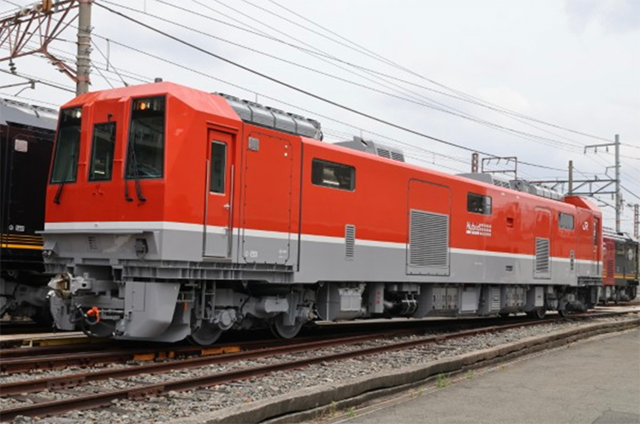
The DEC753 is manufactured by Kinki Nippon Sharyo. In fact the model is almost the same as that to be introduced on the Sagano Scenic Railway (also known as the Sagano Romantic Train) with its DEC743-1001. Sagano Scenic Railway that runs along the old Sanin Main Line route that runs along the Oi River in the Arashiyama area of Kyoto and replaces an aging DE10 diesel locomotive. The plan is that when the Sagano Scenic Railway is undergoing maintenance or otherwise out of service, JR West will provide one of two units that are fitted to be able to haul the Sagano Scenic Train.
The Sagano Scenic Railway is a subsidiary of JR West
Of note is the red livery of the JR West DEC743. These units have been designed to look like the 1950s JNR DF50 diesel electric locomotives. JR West will acquire 8 DEC743 units.
Japan Rail Enthusiast Magazine Quick News
Kintetsu train derails outside Kintetsu Kyoto Station
On the 29th June 2026 a Kintetsu train derailed outside Kyoto Station. the train was the first departure from Kyoto Station (5:12 to Kashiharajingumai) and derailed whilst switching lines on points immediately outside the station. The train was one of Kintetsu’s new 8A four car electric multiple units. The 2nd & 3rd cars derailed. The train was only travelling at 20km/h and no one was injured in the accident.
Investigators are looking into whether there was any defect on the points or a fault with the trains bogies, with special attention being paid to the fact that the train was relatively new.
Services on the Kintetsu Kyoto Line were impacted for about 1 1/2 days until the train was moved and track repaired.
News report https://www.youtube.com/watch?v=LI7HD3mkkhY
JR Kyushu Hisatsu Line now reopened between Yoshimatsu and Hayato following 11month closure
Following extensive storm damage in August 2025, the Hisatsu Line was fully reopened between Hitoyoshi and Hayato. The section between Yoshimatsu and Hayato was reopened on July 12th after repairs to flood damage caused in August 2025 . Although originally slated to reopen on 28th June, it had to be postponed due to further storm damage.
JR Freight officially closes the Tsuchizaki and Akita Port freight only section of the Uetsu Main Line…
On 1st July the Tsuchizaki~Akita Port section of the Ou Main Line was officially closed as was the Akita Port Station. This 1.8km .ine was one of only 9 lines that were operated exclusively by JR Freight. At Akita Port Station, JR Freight used to exchange freight trains with Akita Rinkai Railway that operated 7.9km of track in the Akita port Area before it closed in March 2021.
JR East had operated the occasional passenger train to Akita Port, in a unique situation where JR East held a type 2 license to operate trains on a JR Freight Line. A temporary platform had been built at Akita Port Station. With the freight line now officially closed these services have not been able to run since 2025.
JR Freight has a freight terminal station in Akita on the Ou Main Line.
JR West – Its official the 500 series shinkansen and the T5 Doctor Yellow to retire in January 2027


500 series shinkansen
Last day of regular operation will be 13th January 2027. As now, the 500 series will only be used on Kodama services. The actual services it will be used on can change, but the monthly timetable shows which services the 500 series is scheduled to operate.

Note: timetables are updated monthly and services which are rostered for 500 series can change. Due to unforeseen circumstances even where rostered different trains could be used (e.g. 700 or N700A/a).
Currently there are 4 units still in service
After 13th January 2026, the 500 series shinkansen will be used to operate special services (event and charter services) up till July 2027 when the final units will be fully withdrawn.
Doctor Yellow
As per normal practice JR West (and JR Tokai) do not advertise the operational times of Doctor Yellow runs (although if you know where to look times can be found on rail enthusiast sites and blogs).
As such the last run for Doctor Yellow, unit T5, has not been published, but JR West has confirmed that it will be in January 2027 (see April~May 2026 edition for “Doctor S” )
Generally the last remaining Doctor Yellow, JR West’s T5 unit, runs every 10 days departing Tokyo late morning and arriving Hakata in the evening; the return journey normally happens the next day, leaving Hakata mid morning and arriving Tokyo early evening. There are also some Hakata~Shin Osaka runs.
SL Gunma D51 498 seen out on testing runs…
Following regular maintenance and an accident both of the JR East Takasaki based Steam Locomotives (C61-20 & D51-498) have been out of service and both SL Gunma Minakami and SL Gunma Yokokawa have been cancelled so far this year and on some occasions the trains have been hauled by JR East’s GV-197 engineering train.

Although there have not been any special announcements, D51-498 has been seen on test runs (with GV-197) on the Joetsu Line.
Again no official announcements, but hopefully SL Gunma services may start running later this year??
[D51-498 has been out of service since July 2025 following a brake related incident. On the morning of the 4th September 2025 it derailed whilst on a test run following the earlier incident, on the Joetsu Main Line: C61-20 has been undergoing periodic overhaul since August 2025,
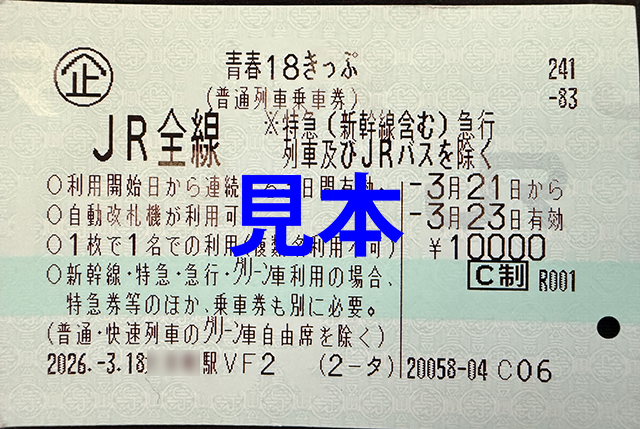
Big drop in Seishun 18 Kippu ( Youth 18 Ticket) sales since rule change in 2024
Following the changes in the Seishun 18 Kippu in 2024, there has been a big drop in ticket sales; from 720,000~740,000 tickets annually between 2015~2017 to 240,000 in 2025. The 2025 number is actually lower than the number of 2020 the year the Covid Pandemic started (250,000).
The Seishun 18 Kippu was designed for students and is only available during college holidays. and is valid on all JR local and ordinary rapid trains throughout Japan. There is however no age limit and the ticket is popular with older people and also local rail enthusiasts. You can get more information on the ticket and the changes that occurred in 2024, together whether the ticket is still good value for rail enthusiasts (although a local ticket it is available to everyone, including inbound visitors) in this article in our March 2026 Rail Enthusiast Magazine Seishun 18 Kippu – is it a good ticket for rail enthusiasts.
As part of our itinerary planning service, TS Japan Rail checks what are the best tickets for your trip, both from a cost and convenience perspective.
Trains to look out for…
(New)JR East E723-5000 series Ou Main Line (Yamagata Line Fukushima~Shinjo; standard gauge)
The first E723-5000 units, which will replace the 719-5000 standard gauge units have been delivered and are under going testing and crew training. The units will be going into service in the Autumn of 2026. The 723-5000 units will provide a much needed upgrade in passenger upgrade and operating efficiency.
(New)JR Tokai 385 Limited Express Shinano units
The first 385 series Limited Express Shinano unit is undergoing testing on the Chuo Main Line West. As part of JR Tokai’s upgrading of its rolling stock, the 385 units will replace 383 units which were introduced in 1985. The new trains will provide a big upgrade in passenger comfort as well as operating efficiency. The Limited Express Shinano operates between Nagoya~Matsumoto~Nagano.
[Retro Livery] JR East E653 Limited Express Inaho with JNR 583系Livery
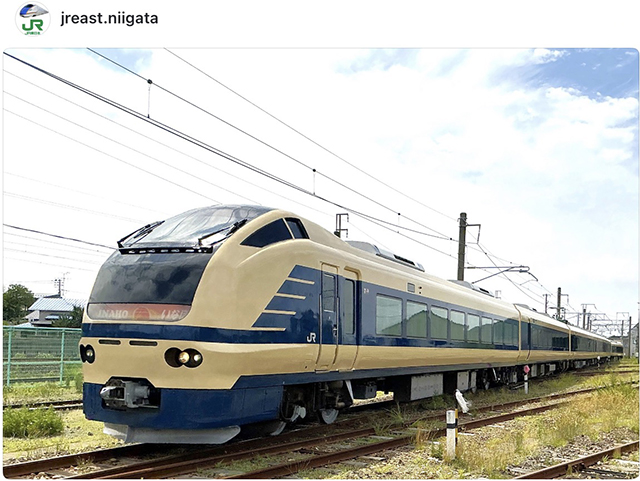
On the 18th July, E653 unit 101 debuted on the Limited Express Inaho service with its new retro livery. It is now sporting the blue & cream Gekko (moonlight) livery used on the former JNR 583 series which used to operate on the Uetsu Main line Nihonkai & Yuzuru Express services.
The 583系 was a special train designed so that it could be operated during the day time as a normal express train and with a quick conversion of seats to sleeping berths
(picture JR East Niigata Social Media)
The Limited Express Inaho service operates between Niigata & Sakata with two daily services running to Akita. It runs along the scenic Uetsu Main Line along the Japan Sea Coast.