Yamaguchi – A look back to the late JNR days with the workhorse 115 series, the urban~rural 105 series and the ex baggage car turned passenger car 123 series
It is often in those areas that inbound tourists whizz by in the shinkansen, not knowing that there is much more to Japan that is not shown on social media or their (English) guidebooks, that for different reasons are also very interesting for rail enthusiasts.
Yamaguchi Prefecture is one such place. It is probably the best place today to see some of the JNR era electric units that have been long retired in other areas. Trains such as the 115 series, which once could be seen all over the 1500V DC network in Honshu; or the 105 series designed for the semi urban / rural areas of Western Japan, and may be the most interesting the 123 series that started life as baggage cars but were converted to passenger cars at a time that JNR had a surplus of baggage cars, no cash and needed some (relatively more) efficient one car units to replace pre war units.
There is more to Yamaguchi than the SL Yamaguchi for rail enthusiasts. In this article we explore the “Last Bastion of JNR Electric Units!
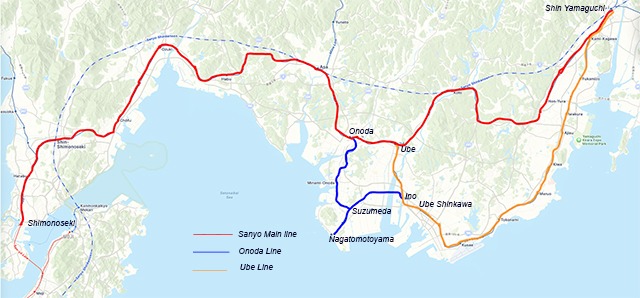
The area covered by this article is shown in the below map (although there are some references to other areas).

Setouchi Yellow
One thing we did not mention above is that most of the electric units, at least the former JNR ones are all liveried in the striking “Setouchi Yellow”. In the days before plain stainless, JR West wanted to simplify things and save money so decided to use one colour liveries. For its Okayama-Hiroshima-Yamaguchi area (i.e. the Setouchi area) “Setouchi Yellow” was decided upon. (there are some units carrying different liveries, and newer units have different liveries).
Video

Sanyo Main Line 115 series

The Sanyo Main Line runs from Kobe to Moji (although trains from Shimonoseki go through to Kokura). It connects to the Tokaido Main Line at Kobe, which together form the main conventional rail trunk route between Tokyo, Chubu, Kansai, Chugoku and Kyushu. Before the Tokaido and Sanyo shinkansen lines were opened it was a very important route with many through services. Today, although still important and busy it mainly conveys shorter distance passenger services, but many long distance freight trains. It should also be noted that between Shimonoseki~Moji the line is owned by JR Kyushu and operates at 20KV AC rather than 1500V DC, so only JR Kyushu’s dual voltage trains can operate on this section (and JR Freight uses dual voltage locomotives).
About the 115 series
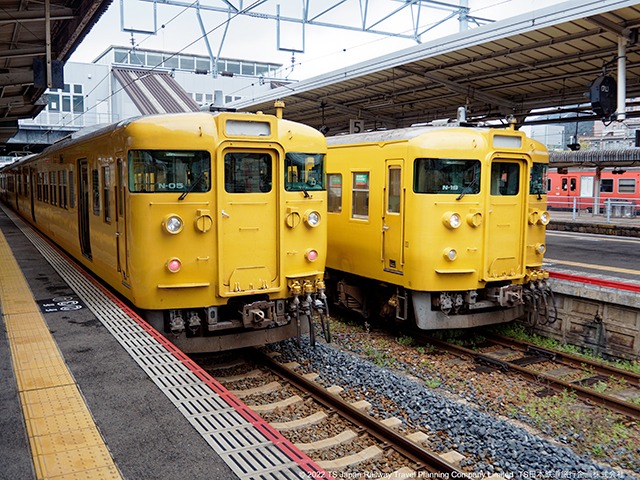
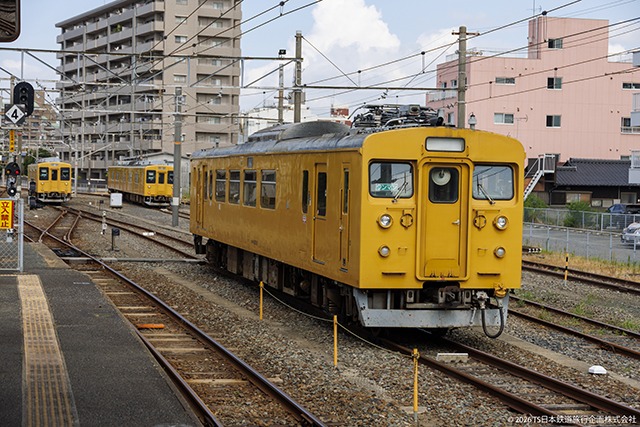
The 115 series was designed and built for Japan National Railways (JNR) back as far as the 1960s. It is a 1500V DC powered train and built for colder areas with enhanced braking, more powerful motors and semi automatic doors. They were very common across Honshu (1500V DC areas) and used for longer distance commuter routes and some rural routes.

Today of the JR companies, only JR West has 115 series in operation. The version of the 115 (3000 series) that JR West operates today, date back to the 1980s.
These units are different from other units as they have only 2 doors (on each side) rather than 3, and the doors are semi automatic. The reason for this is that they are used for more longer distance services (for example the 182km Iwakuni to Shimonoseki on the Sanyo Main Line) so by reducing the number of doors from 3 to 2 the number of seats could be increased. Also as they are not used for heavy commuting routes with concentrated stations, dwell times are less of an issue.

Some of the 2 car units that survive today have a distinctive feature. The cabs at either end are very different shapes.
At one end the the cab is the standard curved shape seen on 115s, but on the other end the cab has a flat shape.
The story behind this is that these units were cobbled together using a 115 series Driving Car (non powered) and a non driving powered car, which was converted to a driving car, but the cab shape was made more straight (sometime referred to as the “bread loaf” shape cab.
This was done as this cab design was cheaper than the design normally associated with the 115 series cab. These units however are getting harder to see as most have already been withdrawn. Shimonoseki had 4 such units as of 1st April 2026. (the last one that the author saw was at JR West’s Shimonoseki works being scrapped)
The 115 series is a “dying breed” and will disappear in a few years time.
JR West is replacing all of its Shimonoseki and Okayama based 115 series units with new 227 series units. (as at 1st April 2026 JR West had the following 115 units: Okayama – 4 four car units, 11 three car units & 8 two car units (for use on Sanyo Main Line, Ako, Hakubi & Fukuen Lines); Shimonoseki had 4 two car units and 18 four car units (all for use on the Sanyo Main Line)).
In the Hiroshima area all 115s have been replaced by 227s and in the Okayama area few services are now operated with 115 series units. Although no date has been given, the replacement of 115s in the Yamaguchi area with 227-500 series units has started and likely to be completed in the next 2 to 3 years.
JR East and JR Tokai no longer operate any 115 series, although you will occasionally see Shinano Tetsudo 115 units on the Shinonoi Line between Shinonoi and Nagano. Shinano Tetsudo as at 1st April had 4 three car units including S8 its restaurant train, but except for this unit it is in the process of replacing with SR1 series units (based on JR East E129 series)
About the 105 series
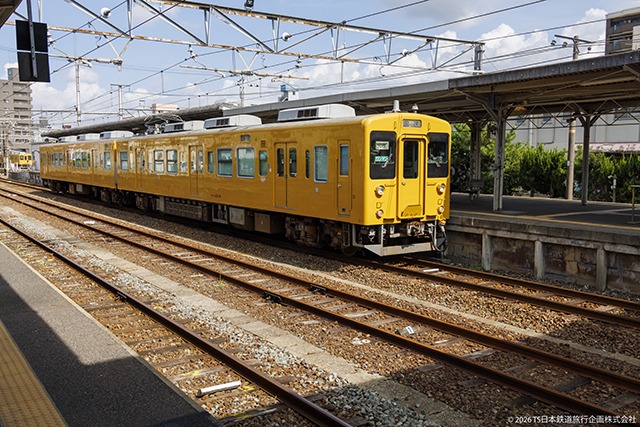
The 105 series was introduced in the early 1980s particularly for Western Japan to provide a more economical train for rural and less populous urban areas, than the 101 & 103 series trains used in the more concentrated urban areas such as Greater Tokyo and urban Kansai area. These are 1500V DC units 2 car units with one motorised and one trailer car.

There are in fact two types; a 3 door version, which were built from new and a 4 door version, which are actually a rebuild from the 103 series. The 4 door version, which operated mostly on the Wakayama Line (Wakayama) and Kabe Line (Hiroshima). All of the 4 door units have long been retired, but the 3 door version is still in use on the Ube Line and to some extent on the Onoda and Sanyo Main lines.
Where can you see the 105 series?
Today the 105 series is used on the electrified part of the Fukuen Line (Fukuyama~Fuchu) with 7 units based at Okayama. They also operate on the Ube Line and a few services of the Onoda Line. These services used the 9 units based at Shimonoseki.
One of the Shimonoseki 105 series units (K02) used to operate on the Kabe line and has been repainted in its old JNR era Hiroshima livery of white with blue and red lines, (there are two other ex Kabe Line units but both are in yellow livery K01 & K06).
K02 is seen here at Shin Yamaguchi with an Ube Line service.

Future
At the current time JR West has not made any announcements on the future of the 105s. It has only just started the replacement of the Sanyo Main Line 115s with the new 227-500形 units. Considering, however, that the 105 units are around 40 years old and using old technology and are not particularly energy efficient compared to modern trains, the expectation has to be that the 2 car version of the 227-500 units could be a possible replacement in future.
About the 123 series
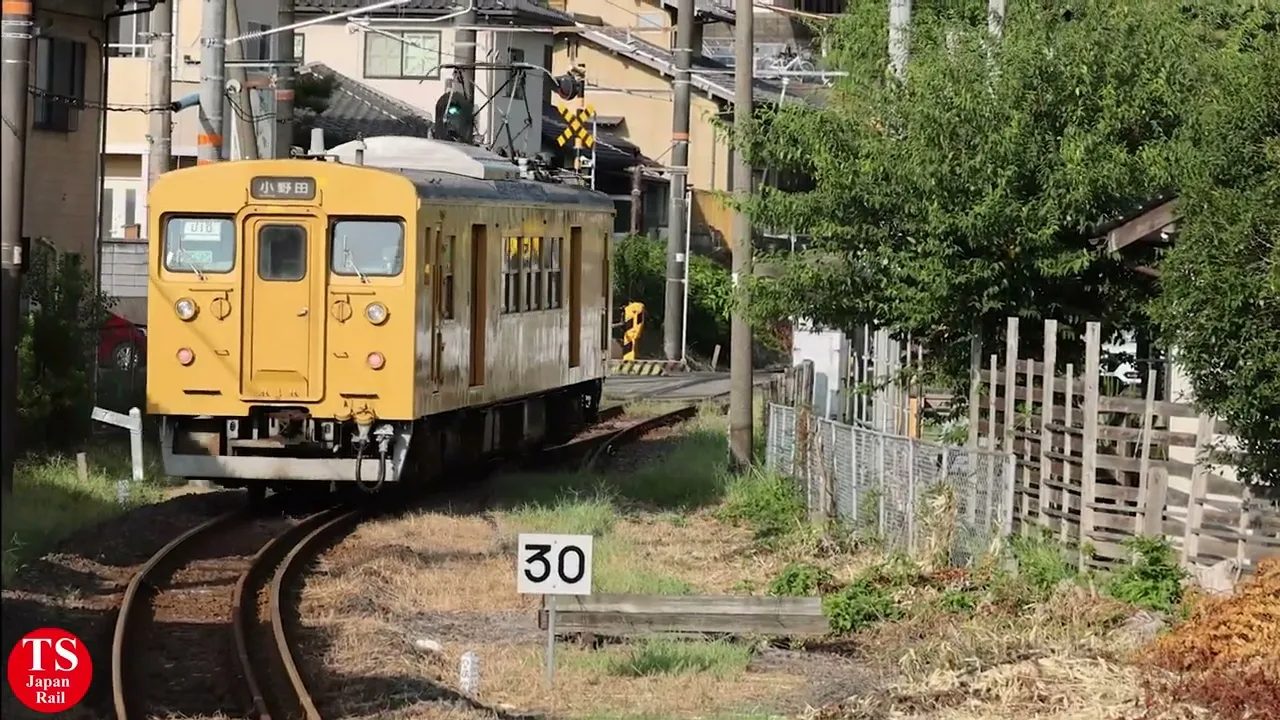
Of the three types of train featured in this article, the 123 series is probably the most interesting. Today it only operates in Yamaguchi Pref on the Onoda Line and Ube Line, in the Ube area of Yamaguchi.
Prior to the privatisation of JNR and the forming of the JR companies, JNR, which was in severe financial crisis at this time, had the problem of diminishing ridership on rural lines and needed to save costs. At the same time its postal / baggage / luggage services were in decline (in fact JNR ended most of these services) which meant it had a surplus of motorised baggage cars.
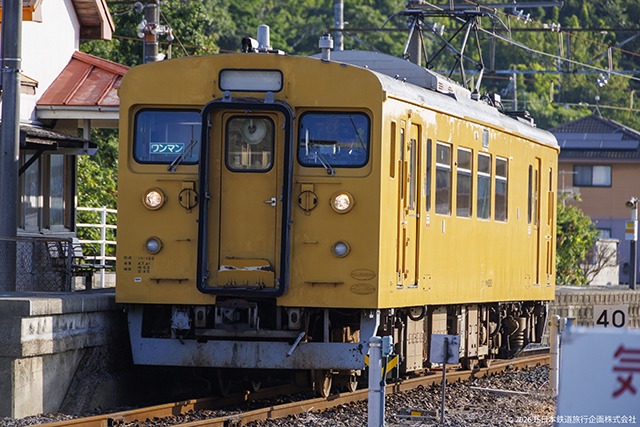
The idea was to use one car trains, that could operated on a “One Man” basis, however there was shortage of such cars, particularly electric ones. It was decided to convert the surplus motorised baggage cars (series 143,145 & 147) into passenger cars.

In total 13 such conversions were made, and they were classified as 123 series. As they were converted from three different baggage car types, the 123 series did not all look the same and the door positioning differed.
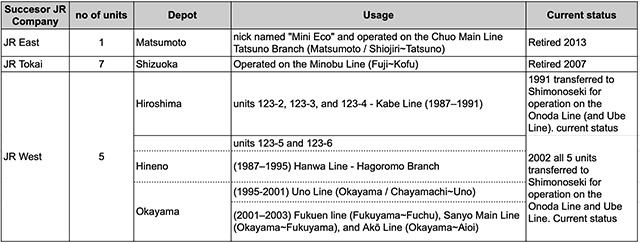
The 13 units were allocated as such:

Where can you see 123 series
They mostly work on the Onoda Line (Onoda~Ino) and through to Ube Shinkawa on the Ube Line. They also work the Onoda Line Motoyama branch between Suzumeda and Nagato Motoyama. They also operate a small number of services on the Ube Line.
[note the Onoda Line Motoyama branch just has three trains a day in each direction, 2 early morning and 1 evening service]

The future…
Like the 105 series, there has been no announcement on the future of these units. the Onoda Line Motoyama branch can only take 1 car trains so even a 2 car 227-500 unit will not work (it will work on the main part of the Onoda Line). the options that JR West has:
- Close the Motoyama Branch – it is not a heavily used and only has 3 trains a day in each direction (heavely used by rail enthusiasts). JR West could then in future use 227-500 two car trains on the Onoda Line.
- Use one car diesel or hybrid units (for this to make sense you would need to use on the whole of the Onoda Line, not just the branch and probably the Ube Line as well)
Neither the Onoda Line or the Ube Line are profitable which puts JR West in a difficult position; 1) do you start the process to close the lines or 2) invest in more efficient trains to save money, which could include buying new 227-500s for the line.
[note the above is just speculation]
The only thing that is certain, if you want to see these 3 JNR era trains in operation, you cannot wait too long!
Other reasons for rail enthusiasts to visit Yamaguchi Prefecture
This article has just concentrated on the three Electric Multiple Units that Yamaguchi Prefecture is the best place (only place) to see. There are however other reasons to visit Yamaguchi as a rail fan, such as the SL Yamaguchi, diesel traffic on the Yamaguchi and San’in main Lines, freight traffic on the Sanyo Main Line coming across from Kyushu (locomotive changes near Shin Yamaguchi) and JR Kyushu dual voltage JNR 415 -1500 series trains at Shimonoseki station (although these are due to be replaced with Joban Line E501 series acquired from JR East (and will be renumbered 501) from 2028.
SL Yamaguchi
A big attraction is of course the SL Yamaguchi. Arguably the best, but at least one of the best steam rides. It is also good for linesiding. Read more in this article:

Other TS Japan Rail Posts featuring Yamaguchi