Welcome…
This month’s Japan Rail Enthusiast Magazine comes from a hot and steamy Tokyo. When I started writing this introduction I was concerned that there was not much news, and in particular not much positive news for this month, and although our aim is to be realistic and not to romanticise Japan railways, we do like to be balanced! There was quite a bit of negative news, mostly due to nature – earthquakes and rain, but with a bit more delving than normal we found quite a bit of positive news!
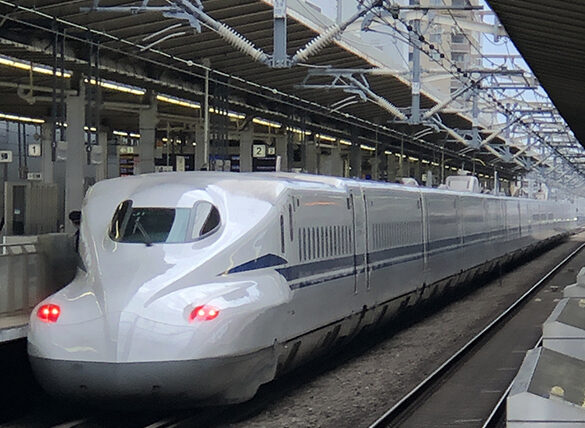
August is a time when the JR railway companies are looking at extra traffic due to the Obon holiday in Mid August – this year traffic was up on 2025 but still down on pre-covid levels.
I took part in a TV program segment, more about that below. TSJR also attended the 25th International Model Railway Convention, which was very good with a lot of interesting displays.
Stephen Turner
JR Rail companies report a busy Obon holiday period, but rail travel is still below pre-covid levels Tokaido Shinkansen carried a record 4.1 million passengers!

The buddhist holiday “Obon” which is mainly celebrated in Mid August (although technically the actual dates differ from region to region, with many temples in Tokyo celebrating Obon in July) and it is one of the three big holidays that many Japanese travel back to their hometowns, or travel for vacation. although not a public holiday, many companies close down for Obon, and those that stay open, and also public offices, tend to slow down a bit.
Obon is celebrated between 13th and 16th August, but depending on how the weekends fall and the one unrelated public holiday on the 11th August (Mountain Day) the busy travel period is often extended beyond these dates, sometimes for more than a week. In 2026, the busy travel period was Friday 7th August to Sunday 16th August.
You can check all of Japanese holidays and the busy travel periods surrounding them on our main site with our Japan holiday calendars
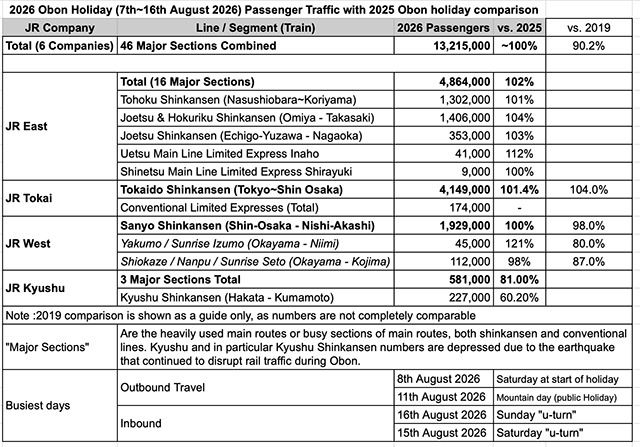
The JR companies operate many extra shinkansen and limited express services over this period. JR Tokai operated 434 trains on the busiest days of the holiday, which compares to a daily average of around 380 trains a day. During this year’s Obon holiday period, JR Tokai carried a record 4.15 mln passengers on the Tokaido Shinkansen! At peak times 13 Nozomi train services were scheduled per hour (one every 4.6 minutes). Slower Hikari and Kodama services were slotted in between the Nozomi services.
Overall shinkansen & Limited Express passenger numbers, which are calculated based on the busiest routes and through the busiest segment, was about 13.2mln which is similar to last year. Here is a breakdown:

JR Kyushu and the Kyushu Shinkansen numbers were depressed due to the earthquake in July which meant that services were restricted (see more later).
It is worth noting, however, that although the comparison with the 2025 numbers are generally flat to good, comparing with 2019 (year before Covid Pandemic), passenger numbers have only reached 90% of pre-covid levels.
Earthquakes and heavy rain (and accidents)

- 2026 Kumamoto Earthquake
On the 28th July a 7.1 magnitude earthquake struck Kumamoto Prefecture. The earthquake caused structural damage to the Kyushu Shinkansen and Kagoshima Main Line, to the extent that it be at least into September before they fully reopen. Hisatsu Orange Railway Line is also partially closed.
Kyushu Shinkansen services between Kumamoto and Shin-Minamata are suspended due to infrastructure damage. Kagoshima Main Line is closed between Uto and Yatsushiro and the Hisatsu Orange Railway is closed between Yatsushiro and Minamata. This means that the only way to reach Kagoshima by rail from North Kyushu is via Oita and Miyazaki (Nippo Main Line).
JR Freight has been using trucks to transfer container freight between Kagoshima & Yatsushiro and Kumamoto and Kagoshima and Nobeoka (Nippo Main Line). Up until 21st August JR Freight has been running some Nishi Oita freight Station trains as far as Nobeoka, however from 22nd August the plan is to run trucks only between Kagoshima~Yatsushiro~Kumamoto
- August 2026 Linear Rain in Chiba Prefecture
On the 13th August extremely heavy rain hit the Kanto area and parts of Chiba Prefecture in particular. JR Sotobo and Uchibo Lines and the Kominato railway all suffered structural damage to tracks. Other lines in the prefecture including those of Keisei and JR East suffered power failures and operating difficulties in general. Although particularly heavy in parts of Chiba Prefecture (which counted 10 rain related deaths), much of the Kanto region was under heavy storm warnings during the afternoon and evening of the 13th causing widespread disruption to public transport.
As of the 23rd all JR Lines were operation (the Sotobo Line fully reopened on the 23rd) and Keisei Lines were all operational, with restrictions, on the 14th (now operating normally). the Kominato Railway is not operating between Satomi and Kazusa-Nakano and currently there is no date for resumption of services on this segment, however the company is working to restore the line.
- 23rd August strong earthquake rattles the Kanto region
At 2am a strong earthquake (Magnitude 5) in Ibaraki Prefecture. It led to train services operated by JR East & Tobu and some smaller operators being suspended and delayed on lines north of Tokyo (particularly Joban Line, Utsunomiya Line, Ryomo Line & Tobu Tokyo Sky Tree Line), and because of the extensive through running of services there was also delays throughout the Greater Tokyo region. All lines were running by early afternoon but with delays and alterations.
- Fatal accident on the Tobu Nikko Line disrupts services to and from Nikko
A fatal accident on the 20th August resulting in the death of 4 workers on the rail tracks at Shin Kanuma Station in Tochigi. The 4 were part of a larger group of workers clearing weeds from the track when a Limited Express Spacia X service from Tobu Nikko to Asakusa struck them.
The Japan Transport Safety Board and Tochigi Police are currently investigating whether safety procedures were adequate and whether they were being carried out properly (Tobu’s procedures require at least 2 look outs, one (or two if lines are bidirectional) in the distance looking out for trains and 1 where the work is being done to ensure workers have cleared the line when trains are approaching). All railway companies in Japan have been instructed by the Ministry of Land, Infrastructure, Transport & Tourism to review there safety procedures for track working. This becomes more relevant as railway companies switch more work to day time rather than night time to try and beat staff shortages.
Although Japan’s railways have a well deserved reputation for reliability, delays and disruption does happen from time to time.
When it does happen you can be sure that everything that could be done to ensure that services return to normal as quickly as possible is being done, of course keeping an eye on passenger and staff safety.
Like everywhere else in the world, Japan is subject to natural disasters, may be more so than some countries.
One big advantage of using TS Japan Rail to plan your trip / tour to Japan is that we are based in Japan and have access to all the information. We will check before your tour and also during your tour to ensure that everything is running as planned and will advise you on any changes they may be required. (we also provide in country support to individual travellers for a small fee)
For example on a rail enthusiast tour earlier this year a typhoon meant the tour had to make a diversion. We were able to decide how the diversion should be made thus minimising the disruption to the tour.
25th International Model Railway Convention
The 25th International Model Railway Convention (also known as the JAM convention) was held at Tokyo Big Site (東京国際展示場) exhibition centre 21st~23rd August.


It was a massive event, but with plenty of railway modellers and others and many displays it was still very crowded. Although most displays were of a Japanese theme (and the main theme was Shinkansen) there was some European and North American themed displays (and many Japanese themes other than shinkansen).

The International Model Railway Convention started in 2000 as the JAM Convention (JAM=Japan Association of Model Railroaders / 日本鉄道模型の会), but in 2014 was taken over by the International Model Railroad Convention Executive Committee and combines both commercial exhibitors, and amateur society and individual exhibitors making it the large event that it is now. It is generally held at the Tokyo Big Site in August for 3 days (Friday~Sunday).
If you are into Model railways this is a show definitely worth visiting (although August is not the best time to visit Japan)
<= RASS no 10 steam locomotive 762mm gauge
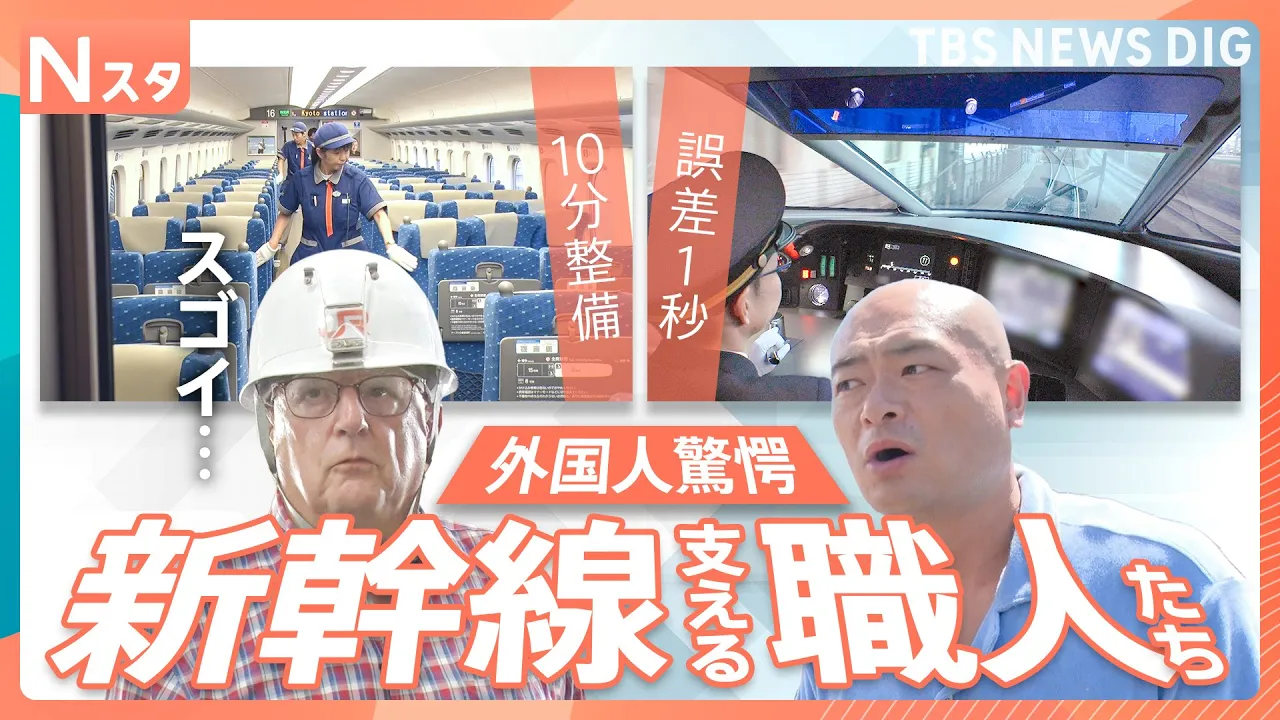
TSJR’s Turner appeared on TBS’s (Tokyo Broadcasting System) Nスタ (N Sta) News program
A lot of work and dedication goes into making sure your train is clean and on time…
On the 18th August (had to be rescheduled from 13th Aug dues to the heavy rain in the Kanto region, see above) TSJR’s Turner appeared in a segment of the major TV station, TBS’s late afternoon / early evening news and information program Nスタ (N-Sta).
TSJR’s Turner learnt that a lot of effort and dedication goes into ensuring all of JR Tokai’s Tokaido Shinkansen trains leave clean and tidy…and it is not all manual work…
The segment was mostly about the cleaning of shinkansen trains at Tokyo Station between arrival and departure. The program also visited the JR Tokai Tokyo Shinkansen Depot.
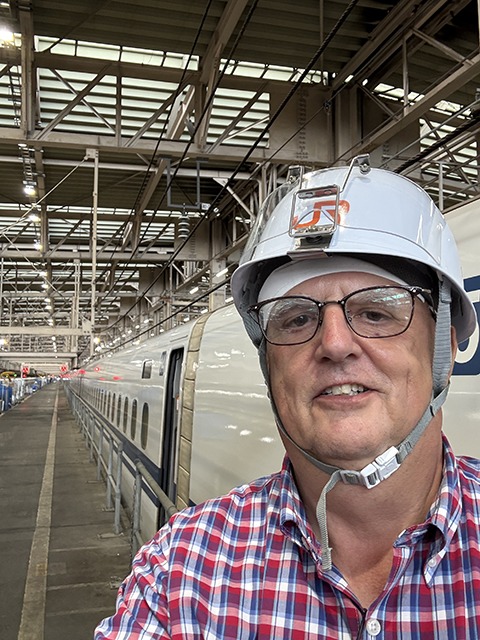
Did you know that between arrival and passengers disembarking from the train, cleaners have only 10 minutes to turn the seats and clean the train before passengers have to board for the next service. Just looking through the windows you do not get feel of how much effort and dedication goes in to this to ensure that trains run on time and are clean!
We have published a story on this on our main website Click Here

Quick News
Keisei release image of new 3900 series Limited Express
As already announced Keisei will launch a new Limited Express service in 2028 linking Narita Airport to Oshiage, where it will connect with the TOEI Asakusa Line (subway) for services to Haneda Airport.

The eventual plan is for the train to run (as a limited express) through to Haneda Airport via the TOEI and Keikyu Lines (as some rapid trains do today).
The train is capable of travelling at 160km/h (all the lines involved are standard gauge). are will be able to travel between Narita Terminal 2 and Oshiage in less than 35 minutes. It will feature a Premium Class car with 2+1 seating arrangement.
Keisei is asking members of the public for suggestions of a nick name for the train.
Keisei press release: https://www.keisei.co.jp/cms/files/keisei/MASTER/0110/iPgi4yI6.pdf

Tobu’s new 90000 series train debuts – first new train on Tobu’s Tojo Line in 18 years
In August Tobu’s new 90000 series train debuted on the company’s Tojo Line that runs in and out of Ikebukuro and connects with Saitama’s Kawagoe City.
the 90000 series is the latest new train being introduced by Tobu which has been gradually updating its fleet with new more power efficient and with improved passenger comforts.
In total 10 ten car units will be introduced on the line. With full SiC VVVF control units, high-efficiency IMs and LED lighting the 90000 series uses 40% less power than the 9000 series it will initially replace. So far however Tobu has not said whether these units will be able to run through to the Tokyo Metro and Tokyu lines that the 9000 series is able to do. It is also rumoured that the 90000 series is not fitted with equipment to allow it to run through to Sotetsu Line (the 9000 series does not either).
As the Tobu Tojo Line runs along the Arakawa and Shinkashi rivers the front of the train with its interesting curvature is meant to resemble the hull of a traditional Takase-bune boat. The blue colour scheme is also meant to represent water.
Tobu is the largest non JR railway company in the Kanto region in terms of route distance with services running into Saitama, Gunma and Tochigi, and joint services even running into Fukushima.
Tobu Press Release: https://www.tobu.co.jp/cms-pdf/releases/20250326124551SKiZWxlDR0iXiNSWtlbbEA.pdf
JR East’s experimental hydrogen fuel cell train to enter commercial service…
Since March 2022 JR East has been testing Japan’s first hydrogen fuel cell train on the Tsurumi Line and the Nambu Branch Line.
The 2 car train, which was developed with Toyota, has on board hydrogen tanks and 4 fuel cells which produce electricity when the hydrogen reacts with air, charging two 120KW/h Lithium-ion batteries.
JR East plans to start commercial service in the 2027 Fiscal Year (April 2027~March 2028)

The train can travel at 100km/h, although this is not a requirement on the two lines it has been tested and will initially enter commercial service. At 35MPa pressure, which is what is planned for commercial service the train can travel about 70km per hydrogen refill, which is adequate for service on these two lines. The unit is based at JR East’s Nakahara Depot (a sub depot of JR East’s Kamakura Depot).
JR East Press release https://www.jreast.co.jp/press/2026/20260714_ho02.pdf

Meijimura’s Balwin 0-6-0 tank engine back from major overhaul…
After 3 years away for a major overhaul SL9 was finally delivered back to Meijimura in July. It is one of two working steam locomotives that the theme park has (the other being a British Sharp, Stewart & Co 2-4-0 tank engine, which is the oldest operational steam locomotive in Japan).
SL9 was found to have cracks on its main frame and general age related deterioration which took longer than the 2 years originally planned for its overhaul to repair.
The work was done by Tokai Kikan an Oigawa Railway related company that specialises in SL overhaul and repairs.
Meijimura has not yet announced when SL9 will be back in service.