

Introduction
In this edition of the Japan Rail Enthusiast Magazine we list a few events that will be taking place in October. The 14th October is Railway Day in Japan, which commemorates the full opening of Japan’s first passenger railway line that ran from Shimbashi (old station was in the Shiodome area) to Yokohama (close to current day Sakuragicho station). During October, because of Railway Day, there are many events, including depot open days.
The last few weeks have continued to be challenging in some areas for railway companies with torrential rain causing disruption to services. We take a look at some of the more serious incidents.
In this edition we also take a look at JR East’s 209 series electric multiple unit. This series is said to be the forerunner of the modern commuter train in Eastern Japan and the first train to be manufactured under the “Half the weight, half the cost, half the lifespan” philosophy. Currently operating long past its planned lifespan in Chiba Prefecture, it has been announced that the fleet of 75 units is going to retired.
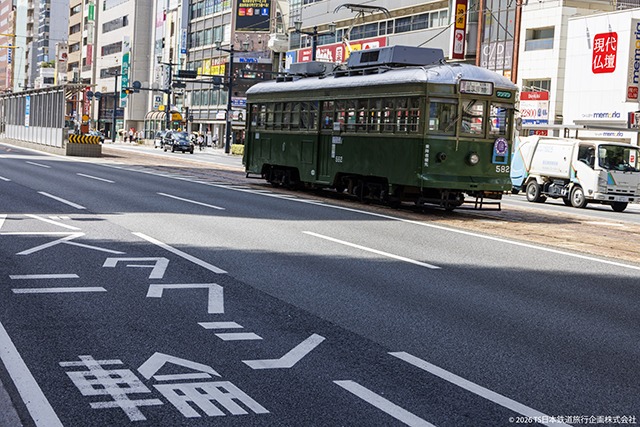
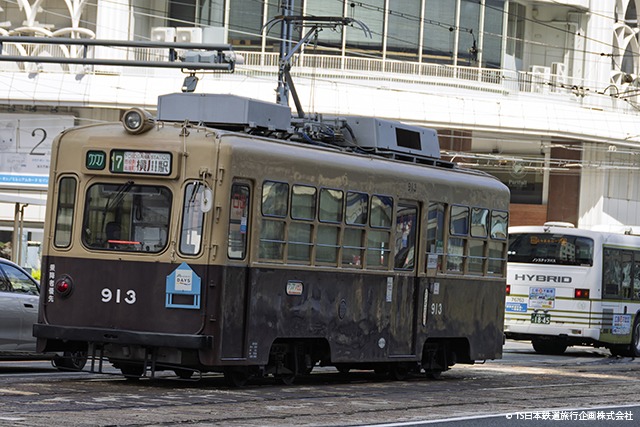
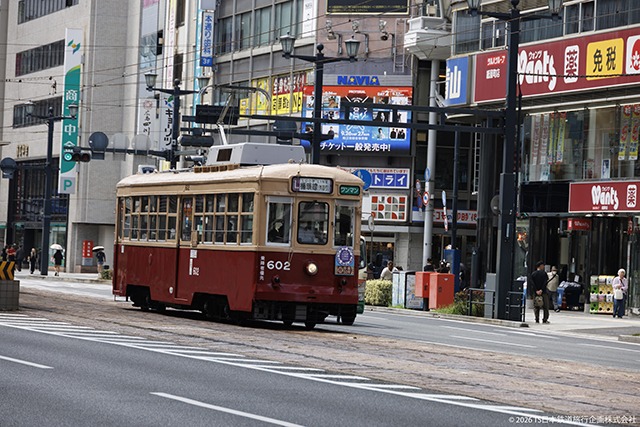
Kintetsu has a new luxury restaurant train is also featured. We also have some advice if you want to see Hiroshima’s vintage trams.
TS Japan Rail
14th October – Railway Day in Japan!
14th October is the anniversary of the completion of first passenger railway line in Japan, linking Tokyo (close to the current day Shimbashi Station) with Yokohama (near to the current day Sakuragicho Station) in 1872 (the section between Yokohama and Shinagawa was completed in June of that year). In those days it took 53 minutes to get from Shimbashi to Yokohama. Today it takes between 32 and 42 minutes (Shimbashi ~ Sakuragicho) depending on what route you travel on, and only 25 minutes to travel between Shimbashi and the current day Yokohama Station.
So, getting back on point, 14th October is designated as Railway Day in Japan. It is not a public holiday, and many people will not actually realise it is Railway Day, as there are many “designated days” in Japan’s calendar (although most are commercial rather than historical).
Many depot open days and other events
As you will see in the listings below, there are many depot open days and other events in October.

We have only listed a few that we think are particularly interesting for international rail enthusiasts and happen at least most years:
- JR East – Sendai Shinkansen Depot Open day (新幹線総合車両ベース) – 24th October 2026 [TSJR highly recommend this event] This is JR East’s main heavy maintenance depot for all its shinkansen trains. It is a large site so although a popular event it does not get too crowded. On the day shuttle trains operate between Sendai and Shin Rifu which is next to the depot. Entrance is free.
- JR Tokai Hamamatsu Shinkansen Maintenance works. 24th~25th October 2026 This is JR Tokai’s heavy maintenance works for its Tokaido Shinkansen fleet. A special bus shuttle operates between Hamamatsu and the works. Note advance booking is required
- J-Trec Niitsu Factory Open Day 10th October 2026 (part of Rail Festa in Niitsu). J-Trec is the JR East train (and other equipment) manufacturing subsidiary, and Niitsu is where one of its two train manufacturing factories is situated, [This is another TSJR recommended event]. There is a shuttle bus from Niitsu Station to the factory (it is also walkable). This is the main event of three that Niitsu holds in October; the other 2 are i) Niitsu rolling stock depot (close to the station) and home to SL C57-180 which can be seen being turned on the depot turntable (every 30 mins) and ii) sepecial events at the Niigata City Niitsu Railway Museum. [Niitsu, nowadays part of Niigata City, is very much a railway town (Niitsu – A Railway Town and Centre of Train manufacturing)
- JR West Shimonoseki General Rolling Stock Center Open Day 17th October 2026 Shimonoseki General Rolling Stock Center is one of JR West’s heavy maintenance depots. This is where JR Rolling stock from Yamaguchi, Hiroshima and Okayama prefectures comes in for heavy maintenance.
- JR Freight Sumidagawa Freight Station Freight Festival – 4th October 2026 – one of two large freight stations serving the Tokyo area. The Sumidagawa freight station mainly but not exclusively, serves freight coming from / to Tohoku region via the Tohoku Main Line and Joban Line. [note: advance booking is required. Residents of Arakawa-ku-free entry; for others an entrance fee is payable.
- Shizuoka Railway Naganuma Depot “Shizutetsu Train Festival 2026” October 17th~18th 2026. Shizuoka’s local railway will be having its annual railway festival at its Naganuma Depot.
- Yokohama Train Festival 31st October 2026 This is an annual event held at the Shintoshi Hall (inside Sogo Yokohama, close to Yokohama Station). Stalls from many railway companies in the Kanto region will be selling railway goods and usually some memorabilia. A good event to learn about both large and small railway companies in the region.
- Hankyu Railway Festival — Shojaku Works, Osaka, 24–25 October 2026 – Depot open day Hankyu, famous for its maroon coloured trains in the kansai region will be holding a depot open day. Note: Advance booking required with timed entry tickets
- Odaiba 33rd Railway Festival 10th-11th October 2026, similar to the Yokohama Train festival, except this one is even bigger with over 80 railway companies and organisations from all over Japan setting up booths selling railway goods and other activities. (East Promenade Odaiba – “Ishi to Hikari no Hiroba” and “Hana no Hiroba”)
- JR Kyushu Kokura General Rolling Stock Center (小倉総合車両センター) Open day 18th October 2026 JR Kyushu’s Kokura Works is the main heavy maintenance works for the company.
Note: This is just a few of the railway events taking place in October, there are many more. You are recommended to check details (or ask TSJR) if you plan to visit any of these or other events. In the event of bad weather some may be cancelled or curtailed. To avoid over crowding and to recover the costs that were once events for local communities, some require advance booking and some also require an entrance fee.
If you are planning a trip to Japan, October is a good month to consider as there many be opportunities to visit some JR and other large railway company depots, which are generally difficult (nearly impossible) to arrange private visits to!
Kintetsu new luxury restaurant train – Les Saveurs Shima (レ・サヴール・しま)

Les Saveurs Shima will debut on the 1st November and is the latest tourist train to be introduced by Japan’s largest non JR railway company – “Kintetsu” (Kinki Nippon Tetsudo).
The train will operate between Kintetsu Nagoya and Kashikojima in the Ise Shima area. this train is truly a restaurant train, with the third car being the kitchen and preparation area, and:
- Cars 1 and 2 provide travellers a view of the Mie Coast Line with angled seats so that diners can enjoy the views. Passengers receive a “French Zen” multi-tiered bento-style boxed lunch packed with local Mie Prefecture ingredients, the preparation of which is overseen by Kintetsu Miyako Hotels. The two cars combined have seating for 34 passengers.
- Car 4 has leather lounge style seating where passengers will be served a full authentic french course meal supervised by Hiroe Higuchi, the Executive Chef of the prestigious Shima Kanko Hotel. This car is limited to just 16 passengers.
Needless to say, advanced bookings are required and travelling on this train will cost more than the normal limited express fare, with the French Zen course costing ¥19,000~¥21,000 and the French Meal costing ¥33,000~¥36,000 (the two prices are weekdays & weekends / holidays) all inclusive of one way travel on the train.
Details https://www.kintetsu.co.jp/senden/les-saveurs-shima/ (Japanese only)
For rail enthusiasts, the important information:
The Les Saveurs Shima train was originally a Kintetsu 12400 series EMU Limited Express set. It has been totally gutted on the inside and on the outside its Kintetsu old style limited express livery of orange and white has been replaced with a metallic blue with gold stripes to represent the sea and luxury. On days of operation it will depart Kintetsu Nagoya at 11:00 arriving at Kashikojima at 13:30. return service will depart of 16:30 arriving in Nagoya at 19:30. It will call at Ise-shi, Ujiyamada, Isuzugawa, Toba, and Ugata.

Info Feature – Want to see Hiroshima’s vintage trams?
On 3rd August 2025 the new Hiroshima Station Tram terminus vame into operation, making transferring between the tram and JR very convenient. This also meant that the tram route to the station had to be changed.
Hiroden (Hiroshima Electric Railway, the tram operator) decided to use part of the abandoned approach line to the station together with some additional track to form a circular route around downtown Hiroshima. This line was planned particularly for tourists (and rail fans). For most of its route it uses existing track / routes. It opened on March 26th, 2026
They also decided that the “Loop Line” as it is called would only operate between 10am and 4pm, but that vintage trams would be used to operate this line.
The below slides show what can typically be seen in a relatively short time (pictures taken at Kamiyacho Higashi)
_Hiroshima-Kamiyacho-Higashi_20260901.jpg)
Heavy rain and the Kumamoto Earthquake cause rail disruption
Kumamoto Earthquake
On September 18th the Kyushu Shinkansen fully reopened, following the earthquake on the 28th July. Damage in the Yatsuhiro area meant that shinkansen trains were not able to travel south of Kumamoto. At the moment due to speed restrictions on the Yatsushiro area there are some small delays and some Honshu~Kyushu services will not operate their full route. This is expected to be only temporary. Fortunately services to and from Kagoshima could restart before the start of the Silver Week holidays (21st~23rd September, but with extended peak travel 19th~27th Sept).
Heavy rain in Chiba Prefecture
On the 13th August extremely heavy rain fell in the Kanto region and in Chiba Prefecture in particular, which recorded 351 mm of rain near to Chiba Station and some other areas even more rain. This led to major cancellation s of services across the prefecture, including services to and from Narita Airport (both JR & Keisei). The Narita Express Sazanami, Wakashio, and Shiosai limited express services were also suspended until the afternoon of the 14th September.
Most services were disrupted with knock on impact across Tokyo and further afield. Heavy rain throuhout the Kanto area caused localised disruption.
Of the most seriously affected JR Lines, the entire Kururi Line, the Togane Line, and sections of the Uchibo and Sotobo lines were suspended due to heavy rain. Due to track damage and sediment inflows the following lines had a delayed restart to services:
- The Kururi Line was able to restart services on the 15th August.
- The Togane Line on the 16th August
- Due to heavy damage on the Sotobo Line between Honda and Oami stations full services were not able to resume until 23rd August
The Kominato Railway suffered much more serious damage and the section between Satomi and Kazusa-Nakano remained fully closed until mid September, with restricted services operating on some days after that. It is not expected to be fully restored until sometime in October.
Heavy Rain in the Nagoya area
On the 8th September record rainfall in the Nagoya area (104.5mm in one hour in central Nagoya) caused major disruption on the Tokaido Shinkansen for several hours after trains were suspended because of heavy rain between Nagoya and Gifu Hashima.
The Nagoya City Subway was completely halted until late evening due to tunnel and station flooding.
The JR Chuo Line (West) had to be suspended between Nagoya and Nakatsugawa after 300m of track between Chikusa and Ozone stations was completed submerged. Services could not restart until the into the morning of the 9th September.
JR Hokkaido Muroran Main Line closed due to heavy rain causing track damage
Heavy rain on the 27th August causing trackbed washouts, debris inflow, and mudslides onto the tracks—particularly between Shizukari and Koboro stations on the Muroran Main Line. Late evening of the 27th August a train was derailed when it hit a landslide near the Entomo Tunnel.
The Muroran Main Line closure meant that the Limited Express Hokuto which links Hakodate and Sapporo had to be partially suspended and a 2 hour long substitute bus service had to be run, turning the 3.5 hour journey into 6 hours.
To relieve the issue, JR Hokkaido crews were able to open the Shin-Entomo Tunnel on September 3rd, thus reducing the bus journey to 50 minutes.
On the 8th & 9th of September JR Hokkaido ran a special Limited Express Niseko service between Sapporo and Hakodate which provided a connection that bypasses the Muroran Main Line, instead uses the mountainous “Yamasen” section of the Hakodate Main Line between Oshamambe & Otaru via Kutchan. Although rail fans and those wanting to explore Hokkaido by Train may have been happy about this diversion, it does add considerably to the time taken to travel between Hakodate and Sapporo.
On September 10th the Muroran Main Line was fully reopened and all services, including the Limited Express Hokuto, were able to operate. This was ahead of initial projections, but required round the clock restoration work.

[Disruption was caused on the 21st Sept as typhoon 25 approached the Kanto region. Lines in Chiba Prefecture as well Izu were suspended due to heavy rain; services in the Boso Peninsula, Izu Peninsula, Oku Tama and Kawagoe Line, Yokosuka Line, Takasaki Line and Utsunomiya Lines are either suspended, partially suspended or facing long delays – diagram as at 18:00 – for illustrative purposes only)]
Summer storms getting more frequent and causing more damage
Although very heavy storms during the summer are not unusual (although visitors to Japan get told about the heat and humidity, they mostly get told it rains in June due to the rainy season, although August often sees damaging rainfall) they are definetely getting more frequent and more destructive.
A good reason to use the services of companies like TS Japan Rail and other Japan based and Japan knowledgeable is that when public transport gets disrupted we can help out our clients.
Do not be discouraged though…
One reason that we can write a piece on travel disruption is that it does not happen that often (which is why it is news in Japan) and Japan is fairly good at getting things moving again (although safety of course takes precedence).
JR East to retire 209 series, the prototype to today’s modern commuter fleet
JR East has announced that from October 2026 it will start withdrawing the 209 series which makes up a major part of its Chiba prefecture fleet:

209 series allocations as at 1st April 2026
| Lines (primary route & Livery) | Depot (designation) | no of cars (per unit) | no of units |
|---|---|---|---|
| Keiyo Line (Uchibo & Sotobo Line through services (Keiyo Line Livery) | Keiyo (no designation unit no 34) | 10 | 1 |
| Musashino Line ( Keiyo Line through services) (Musashino Line Livery) | Keiyo (M) | 8 | 11 |
| various lines in the Boso Hanto area (Boso Livery) | Makuhari (J) | 6 | 1 |
| Sotobo Line, Uchibo Line, Sobu Main Line, Narita Line (Boso Livery) | Makuhari (C) | 6 | 14 |
| Sotobo Line, Uchibo Line, Sobu Main Line, Narita Line (Boso Livery) | Makuhari (C) | 4 | 48 |
| Total | 75 |
The 209 series played an important part in Japanese rail car history
The 209 series was first introduced by JR East in 1992 with 1 prototype and going fully into production in 1993 initially to replace the aging JNR era 103 units on the Keihin Tohoku Line. The original 209-0 series were 10 cars in length
Versions of the 209 were also introduced on to the Nambu Line, Hachiko Line Joban Line (Local Line services) and Chuo-Sobu lines 2 units (ex Joban Line 209-1000形) were even used on the Chuo Rapid Line services as back ups when the resident 233 series trains were being fitted with toilets.
The third sector Rinkai Line in Tokyo, operated by the Tokyo Rinkai Kousoku Tetsudo (東京臨海高速鉄道), 70-000 series train is in fact a 209 series train with modified cab fronts. (these trains are currently being replaced by 71-000 series which are based on JR East’s E233 series)
“Half the weight, half the cost, half the lifespan“
What makes the 209 series important is that it was the first JR East commuter train designed to last half the standard 30 year life span which was normal under the design philosophy “Half the weight, half the cost, half the lifespan.” The idea was these trains were much lighter thus more economical to operate, cheaper to build and the fact that they only had a work life span of around 15 years instead of 30 years was because as technology was developing at such a rate more efficient and generally better specification trains could be introduced much quicker. Of course the 209 design incorporated many recyclable components.


The 209 series is described as the forerunners of today’s JR East commuter train fleet and the “DNA” for JR East’s E231 and E233 series trains which in turn led to the E235 series and E131 series.
Move to Chiba Prefecture
When the Keihin Tohoku Line was upgraded with 233 series units in 2007~2010, most of the units were transferred to JR East’s Chiba Branch. They were re-formed into 8,6 or 4 car units and given the “Boso Livery” (the Keihin Tohoku Blue Line was replaced with a blue and yellow line). Two big internal changes to the 209s were 1) the installation of toilets and 2) was the mixture of boxed and semi boxed seats. The 209-0 series was all longitudinal seating and had no toilets. They were reclassified as 209-2000 & 209-2500 series.
These units replaced the aging 113 series units and also 211 series units that had been cascaded from the Tokaido Main line (most of the 211s were then cascaded to Takasaki and Nagano branches).
The 15 years then became (more than) 30 years…
In reality the 209 series have lasted much longer than the original 15 years life span, although it is true to say that their time on the busy Keihin Tohoku Line was around 15 years, before they were cascaded to a quieter life on the Chiba Boso Peninsula and other rural lines in the prefecture.
The 209 was the first production unit to fully encompass the “Half the weight, half the cost, half the lifespan” philosophy and can be said to be the forerunner of JR East’s 231 & 233 series units which then led to the later 235 & 131 series.
Railfans have nevertheless been waiting to hear when JR East was going to retire them, not least because most are looking their age with their faded liveries.
Replacements

New 3 and 6 car E131 trains will be introduced from 2027. Also some surplus E233 units from various Tokyo area lines (e.g. Chuo-Sobu Local Line) have been / will be modified, reformed into 6 car units and given the blue and yellow Boso livery. The first of these units are already at the Makuhari Depot and undergoing driver training. They will enter revenue service in October 2026
This will also mean that for ordinary trains, after the 209 series has gone all seats will be longitudinal seating.
All trains will be one man operated.
(picture E131-0 series Sotobo Line E131 Boso Livery)
JR East Press release https://www.jreast.co.jp/press/2026/chiba_j/20260910_c02.pdf
Some will survive….
Izukyu railway in Shizuoka Prefecture currently has two ex JR East 209 units (both 4 car units) and is expected to purchase more to replace its aging, ex Tokyu, 8000 series units.
JR East’s experimental train MUE (MUltipurpose Experimental Train) was converted from an early 209-0 series train. It is based at JR East’s Kawagoe depot and still used for test runs on the Ome, Chuo, and Saikyo lines. It was used to develop JR East’s vastly improved Train Information Management System (TIMS). The new version is called INTEROS (INtegrated Train communication/control network for Evolvable Railway Operation System), which was introduced on the E235 series.
It has been rumoured that MUE will be retired, particularly as INTEROS is now in production, but JR East has not made any announcements.
JR East’s Bicyle tourist train B.B. Base, which operates special services for cyclists who want to explore the Boso Peninsula by bike, is also a converted 209 series train. To date there are no plans to retire this train.
Quick News Updates
Timetable changes
Although most timetable changes happen mid October & March, some rail companies have revisions at other times. Keio Electric Railway (Tokyo) Keihan Electric Railway (Kansai), and Eizan Railway (Kyoto) revised their train schedules in September. A driver for the changes was longer dwell times at some station due to the installation of platform doors.
JR Tokai’s Supreme Class Seats
Fares have been announced and as bookings open, seats are selling fast!
We featured these in our Japan Rail Enthusiast Magazine June edition (https://railfan.tsjapanrail.net/blog/2026/06/28/japan-rail-enthusiast-magazine-june-2026/). The premium compartments will be available on certain trains from October and the fares have also been announced.
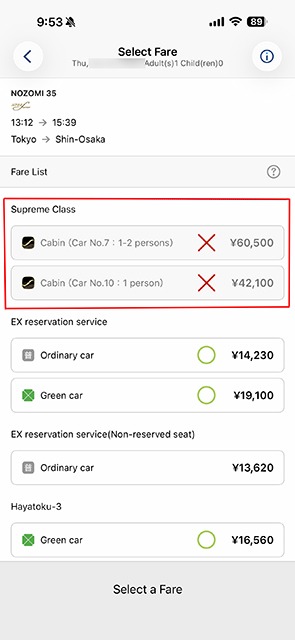
As you will see on the right, the cost for one person travelling from Tokyo to Shin Osaka is ¥60,500 for the larger cabin in car 7 (which can accommodate 2 people(*)) and ¥42,100 for the smaller 1 person cabin in car 10.
The ordinary fares are Ordinary reserved ¥14,230 (14,520) and ¥19,100 (19,390) for green car, if booked on Smart-Ex (in brackets non discounted fare) for mid week.
Needless to say, as you can see from the picture on the left, the supreme seats are selling out fast.
(* for the 2 person compartment in car 7, the second person only needs to pay the unreserved shinkansen fare, so cost for 2 people would be ¥74,120)
It should be noted that the number of trains with Supreme Seats is very limited at the moment.
New trains
JR Hokkaido to introduce new trains for lines in Sapporo area including Airport Rapid service
JR Hokkaido has announced that it will be introducing new trains to replace 721 series currently used on its Airport Rapid service (Otaru / Sapporo~Shin Chitose Airport).
The new trains will be designated 739-3000 series. As well as operating on the Airport Rapid service they will be used on other lines in the Sapporo and Muroran areas.


Like the 721s the new trains will be 6 cars in length, but apart from the premium seat car (car 4) all seating will be longitudinal rather than cross seats that the 721 has. This will increase capacity from 527 persons (279 seats) to 793 (287 seats). The new trains will also have electronic information displays and 6 wheel chair spaces rather than 2.
The new trains will have a top speed of 130km/h and will be the same 2M4T formation of the 721s. the cab profile will be similar to the 733 & 735 series, high and sturdy.
The new trains will be introduce from spring 2027
JR Hokkaido Press release: https://www.jrhokkaido.co.jp/CM/Info/press/pdf/20260918_KO_newairport.pdf (Japanese)
Tobu 90000 series
As reported in previous magazines the new Tobu 90000 series has now gone into operation on the Tobu Tojo Line. Japan Rail Enthusiast Magazine – August 2026
JR East 723-5000 starts revenue service
As first reported in our July Magazine, on the 19th September JR East’s E723-5000 series standard gauge trains started revenue service on the Ou Main Line between Fukushima and Shinjo via Yamagata. This line is shared with the Yamagata Shinkansen, which is why it is standard gauge. Ceremonies to mark the start of service of the new trains were held at Fukushima and Yamagata. the new trains will replace the aging 701-5500 & 719-5000 series units. Japan Rail Enthusiast Magazine – July 2026
JR Freight Looks into freight operations in Thailand
As reported by the Japan business newspaper the Nikkei, JR Freight has been studying getting involved in Thai freight train operations.
In Thailand most freight is carried by truck and the railways do not have a good reputation as far as reliability is concerned.
Working with State Railway of Thailand and Japanese logistics companies Sankyu and Nippon Express Holdings subsidiary NX Thai Logistics, it ran a trial train between Chonburi Station in eastern Thailand and Thanaleng Dry Port Station in Laos carrying 40 foot containers. The trial went well with the train doing the 650km on time and no deterioration or damage to the goods being carried.
JR Freight is examining all aspects of rail freight in Thailand of which this run was a test. If it decides to start business in Thailand, the actual train operation will be with State Railways of Thailand, whilst JR Freight will provide logistics and other expertise. Any JR Freight Involvement is likely to be limited to cross border trans shipments and with Japanese manufacturers and importers in South East Asia.
It will however be a challenge to build up the trust of customers.
Kumagawa Railway fully reopens
The Kumagawa Railway in Kyushu, which suffered major damage during storms in July 2020 was fully reopened on the 20th September after a new bridge, replacing one that had been washed away, across the Kumagawa (Kuma River).
Kuma river Bridge number 4, located between Kawamura Station and Higo-Nishinomura Station, was completely destroyed in the storm in July 2020. The bridge itself, a steel girder bridge, was designated as a National Registered Tangible Cultural Property. unfortunately its concrete piers, as was common when it was built in 1924, were not reinforced and therefore could not stand up to the river forces during the storm.
In November 2021 the railway was able to reopen the section between Higo-Nishinomura and Yunomae (19km). from 20th September 2026, train were able to run to the western terminus of Hitoyoshi Onsen.
Two stations were renamed on the 20th September:
Kawamura Station becomes Sagara-Toshima Station, it has also been relocated to take it out of the Kumagawa flood zone. It has moved about 950m towards Hitoyoshi Onsen. The old station remains as a memorial to the flood. The new station reflects the fact the station is in Sagara Village and its proximity to the Toshima Sugawara Shrine Jinja (shrine)
Higashi-Taragi Station has been renamed Taragi-Shōrenjihad been requested by the local community a long time back due to the stations proximity to the important National Important Cultural Property Shorenji (temple)
JR Hisatsu Line status
The JR Hisatsu Line, which part of its route also runs along the Kuma River and suffered significant damage in the same storm remains closed between Yatsushiro and Yoshimatsu. However in July 2026 JR Kyushu opened the Hisatsu Line Restoration Construction Office and rebuilding of the two bridges that were washed away in the storm is expected to get underway in 2027 with a target date of 2033 for the line to be full reopened. (The Yoshimatsu~Hayato section fully reopened July 2026).
Changes to JR Rail Passes from 1st October
From 1st October the price of JR Rail Passes bought through resellers / travel agents will increase. For example the 7 day ordinary pass will cost ¥53,000 through a travel agent (including non JR online sites) whilst it will continue to be ¥50,000 if purchased through the dedicated JR Rail Pass site (https://japanrailpass.net).
There are also some changes to the JR Shikoku regional passes.
More information on our JR Rail Pass & regional pass guide Click here
For individual / family travellers etcTS Japan Rail highly recommends you use the japanrailpass.net site to purchase JR Rail Passes and in most cases the regional JR Rail company websites to purchase regional passes. A big advantage is that you can start booking trains before you come to Japan! Other web sites will recommend using non JR sites as they receive a commission for directing clients to those sites (TSJR does not receive affiliate commissions as a general policy, where we do we will always tell you up front)
Recent posts of interest to rail enthusiasts





Comments